



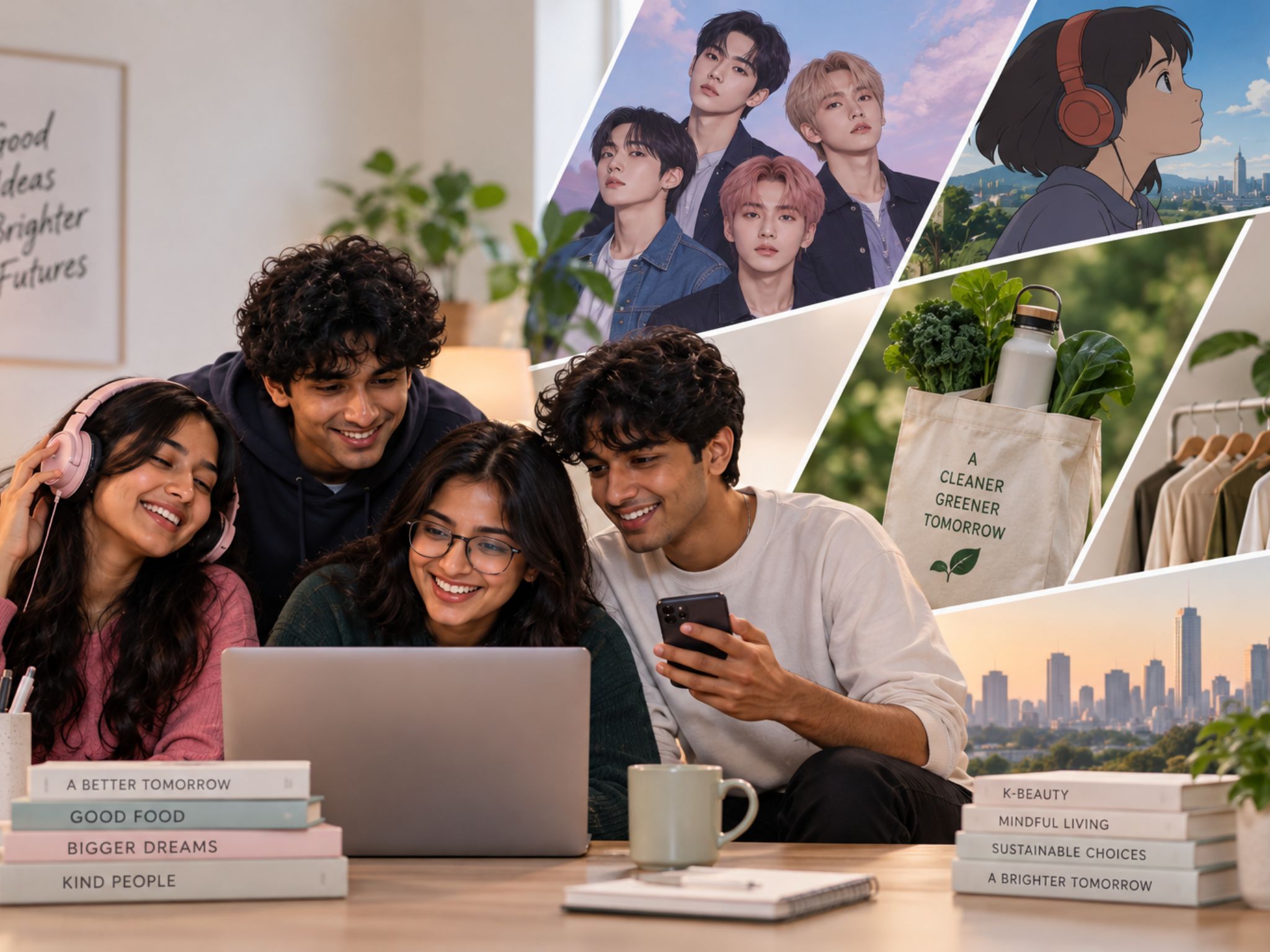
The cultural influences shaping young Indian consumers are undergoing a profound transformation.
For millennials, American popular culture played a central role in defining aspiration. Hollywood, fast food, global fashion labels, American business schools and the promise of corporate mobility all contributed to an identifiable model of upward progress.
Gen Z and Gen Alpha are inheriting a very different world.
Korean music and beauty, Japanese anime and food, digital communities, environmental uncertainty, weaker employment security and more restrained consumption are creating a new cultural and economic framework.
The visible popularity of K-pop, Korean beauty products, anime or Japanese lifestyle concepts is only the surface manifestation of this change.
The deeper shift concerns how younger consumers define identity, aspiration, ownership, belonging and value.
In his article, “Frugality, Climate and K-pop: The New Cultural Economics of Gen Z,” Ankur Bisen, Senior Partner at The Knowledge Company (TKC), examines why the transition from American cultural influence to Korean and Japanese cultural participation cannot be viewed as a simple change in entertainment preferences.
It represents a more fundamental change in the cultural economics of consumption.
Read the original article by Ankur Bisen at: https://mybs.in/2g9GTAn
From Disney to Duolingo: The Rise of Japanese and Korean Influence
Japanese and Korean popular culture have been influencing young Indian consumers for more than two decades.
The early foundation was created by dubbed Japanese cartoons that became part of the childhood experience of millennials and older Gen Z consumers. That exposure has expanded into anime, K-pop, Korean dramas, beauty products, food, language learning and lifestyle concepts.
In the article, Ankur Bisen points to the wider evidence of this influence:
This growth is important because it extends beyond isolated product categories.
A consumer learning Korean, watching Korean dramas, following K-pop performers, experimenting with Korean recipes and purchasing Korean beauty products is participating in an interconnected cultural ecosystem.
For brands, the commercial signal is not simply that one foreign product category is gaining popularity. It is that culture, community, entertainment and consumption are reinforcing one another.
More Than a Replacement for American Culture
It would be easy to interpret the growing popularity of Korean and Japanese culture as a straightforward transition from American influence to Asian influence.
The article argues that the shift is more complex.
The appeal of American culture to previous generations was closely connected with a particular economic narrative: individual achievement, corporate success, upward mobility, home ownership, automobile ownership and visible branded consumption.
That narrative is becoming less universally compelling.
American cultural and corporate institutions are themselves being reassessed amid geopolitical changes, technological disruption, social polarization and economic uncertainty.
At the same time, younger consumers are growing up with more fluid identities. Digital access allows Gen Z and Gen Alpha to draw simultaneously from Korean music, Japanese entertainment, Indian regional culture, global gaming communities and highly specific online subcultures.
The resulting identity is not necessarily Korean, Japanese, Indian or American.
It can be country-neutral, selective and assembled from multiple cultural sources.
This has major implications for companies that continue to segment young consumers only through nationality, income or broad demographic labels.
The Rise of Cultural Fluidity
Young consumers no longer need to adopt an entire cultural system to participate in one part of it.
A person may listen to Korean music, consume Japanese animation, wear an Indian streetwear label, follow a European football club and participate in a global gaming community.
Digital platforms make it possible to move across these identities with very little friction.
This creates a marketplace in which identity is:
For consumer brands, this can make conventional demographic segmentation less effective.
“Urban Gen Z” remains too broad a category when individuals within it may belong to entirely different cultural communities and define status through different symbols.
One consumer may view a limited-edition collectible as highly aspirational. Another may invest in concert travel. A third may prioritize sustainable fashion, gaming accessories, specialist skincare or niche food experiences.
The common factor is not necessarily a category. It is the ability of the product, service or experience to convey identity and community membership.
Peak Americanism and the Search for Alternatives
The article places these consumer changes within a wider reconsideration of American influence.
For previous generations, American popular culture and corporate institutions often represented modernity, success and social mobility.
Today, that image is being challenged by a more uncertain political and economic environment.
The cultural narrative built around American corporate achievement, elite education and asset ownership is becoming harder to reconcile with a world facing employment uncertainty, wealth inequality, climate disruption and rapid technological change.
This does not mean that American brands or culture will disappear from Indian consumption.
Rather, American influence may no longer function as the unquestioned default against which all aspiration is measured.
Younger consumers can now choose from a much wider library of cultural references. Korean and Japanese influences fit naturally into this environment because they offer different visual languages, community structures and interpretations of modern life.
Climate Anxiety and the Shift Toward Frugality
Environmental awareness is not only shaping product preferences. It is also influencing how younger generations understand consumption itself.
Gen Z and Gen Alpha have grown up amid recurring conversations about biodiversity loss, extreme weather, pollution, food systems and climate risk.
These conditions can produce a different relationship with ownership and excess.
Frugality, minimalism, sharing, reduced consumption and understatement may increasingly become elements of cultural identity rather than signs of economic limitation.
This can influence demand across multiple categories.
Young consumers may show greater interest in:
Brands should not assume that every young consumer will become uniformly sustainable or abandon aspiration.
The more important point is that the definition of aspiration is expanding.
A product that communicates restraint, authenticity, repairability or membership in a values-based community may carry as much cultural status as a conventionally luxurious object.
The K-shaped Economic Reality
The cultural choices of younger generations cannot be separated from their economic circumstances.
The article highlights a contradiction facing Gen Z and Gen Alpha.
These generations have been raised during a period of extraordinary digital access and cultural choice, but they are also entering a labor market shaped by automation, temporary employment, gig work and uneven income growth.
Economic gains are not distributed uniformly.
Some technology and specialized roles continue to generate rising compensation. At the same time, automation and restructuring are placing pressure on traditional white-collar opportunities.
This K-shaped environment can create two simultaneous consumer realities:
The result is unlikely to be the disappearance of consumption.
Instead, spending may become more selective, identity-driven and concentrated around highly meaningful categories.
A consumer may exercise restraint across routine purchases but spend significantly on a concert, collectible, beauty regime, gaming product, travel experience or community-linked interest.
This creates a market in which broad assumptions about either “premiumization” or “value consciousness” may be misleading.
The same consumer can exhibit both behaviors depending on the category and cultural meaning of the purchase.
From Asset Ownership to Cultural Participation
Generational aspiration has often been measured through physical assets: property, automobiles, appliances, branded clothing and other visible indicators of economic progress.
Younger consumers facing higher asset prices and less predictable career paths may express aspiration differently.
Cultural participation can become an alternative form of status.
This may include:
This does not mean that ownership will become irrelevant.
It means that brands must recognize that access, participation and belonging can now deliver forms of value once primarily associated with ownership.
For businesses, this changes the product-development and engagement opportunity.
The offering is no longer only the physical object. It can include the content, community, experience, customization and cultural story surrounding that object.
The Rise of Micro-Cultures
Mass-market consumer strategy traditionally relied on broad cultural narratives that could unite large demographic groups.
Gen Z and Gen Alpha increasingly organize around micro-cultures.
These communities may form around:
Micro-cultures can generate intense loyalty, but their signals are easy to misread.
A brand may identify a visible aesthetic and treat it as a short-term trend without understanding the community, values or behaviors sustaining it.
This produces superficial execution: a new color palette, celebrity association, packaging redesign or limited product drop that references the culture without participating meaningfully in it.
The commercial opportunity requires deeper reading.
Brands need to understand:
Cultural intelligence therefore becomes a strategic capability rather than a marketing accessory.
What This Means for Consumer Categories
The article suggests that these cultural and economic changes can affect a wide range of purchasing choices.
Fashion
Young consumers may increasingly prefer relaxed silhouettes, understated styling, flexible clothing and products connected with specific cultural communities.
Beauty
Korean beauty, Japanese formulations and digitally amplified skincare rituals can continue influencing product development, routines and consumer expectations.
Food
Asian cuisines, regional experimentation, higher-protein choices and more deliberate consumption may reshape both packaged food and foodservice demand.
Watches and Accessories
Collectibility, sustainable materials, digital functionality and cultural association may become more relevant than conventional ideas of status alone.
Home and Living
Minimalism, adaptability, smaller spaces and subtle design can gain importance as younger consumers rethink ownership and permanence.
Entertainment and Travel
Experiences, fandoms and cultural participation can capture a greater share of discretionary spending, particularly when physical asset ownership feels less attainable.
These are not guaranteed predictions for every Gen Z or Gen Alpha consumer.
They are strategic signals businesses should investigate against category data, consumer research and specific market contexts.
The Boardroom Challenge for Indian Brands
The most important section of Ankur Bisen’s article concerns how businesses respond.
Companies now have access to unprecedented volumes of consumer information.
Search patterns, digital communities, transaction histories, social conversations and market research can provide signals about changing preferences.
But more data does not automatically produce deeper understanding.
Broad cultural movements can easily become simplified into tactical trends for product design, packaging or communication.
That creates the risk of responding to the visible symptom while missing the structural change beneath it.
The boardroom questions should therefore include:
The objective is not to convert every cultural signal into a new product.
It is to recognize which signals could alter the future economics of the category.
From Trend Tracking to Strategic Interpretation
Consumer and cultural research often identifies what is gaining attention.
Management teams must go further and determine why it is happening, what economic forces support it and whether it can produce sustained commercial demand.
For example, the growth of Korean culture in India could be approached superficially as a content or celebrity trend.
A deeper analysis would examine:
That deeper interpretation enables better portfolio, market-entry, partnership and investment decisions.
How TKC Supports Consumer-Facing Businesses
The Knowledge Company (TKC) works with retailers, consumer brands, investors and market entrants to translate changing market and cultural signals into clearer strategic decisions.
Consumer and Market Intelligence
Identifying structural changes in consumer behavior, cultural participation, category demand and value perception.
Category Opportunity Assessment
Evaluating the size, growth potential, commercial attractiveness and operating realities of emerging consumer categories.
Market Entry and Growth Strategy
Helping domestic and international businesses define target consumers, positioning, routes to market and expansion priorities.
Portfolio and Proposition Strategy
Assessing how changing generational priorities should influence brand architecture, product portfolios, pricing and consumer propositions.
Cultural and Cohort Strategy
Decoding the behaviors, motivations and identities of Gen Z, Gen Alpha and other evolving consumer groups.
Commercial Due Diligence
Evaluating whether emerging categories and consumer shifts represent sustainable market opportunities or temporary visibility.
Omnichannel and Route-to-Market Strategy
Designing channel strategies aligned with how digitally connected consumers discover, evaluate and purchase products.
Understanding Gen Z Beyond the Surface
K-pop, Korean beauty, anime and Japanese lifestyle influences are visible evidence of change.
They are not the entire change.
The larger transformation lies in how young consumers are constructing identities amid a world of cultural abundance, economic uncertainty and environmental anxiety.
They remain aspirational, but their aspirations may not follow the ownership-led path of previous generations.
They may participate deeply in global culture while becoming less attached to any one country.
They may spend selectively on passions and experiences while practicing restraint elsewhere.
They may embrace premium products in one category and radical frugality in another.
For brands, conventional demographic labels will not be enough.
The businesses that succeed will be those that move beyond tracking what Gen Z is watching, wearing or buying and understand the economic and cultural forces shaping those choices.
Is your consumer strategy prepared for a generation redefining aspiration, ownership and cultural identity?
Connect with The Knowledge Company’s Retail and Consumer Goods Advisory team at vidya@tkc.in to explore how generational change, cultural intelligence and consumption economics can inform market, category and growth strategy.
Get the strategy behind the retail headlines. Subscribe to TKC’s free newsletter.