



India’s ₹5 snack packet has long been one of the packaged-food industry’s most important commercial instruments.
It gives price-sensitive consumers access to branded products, supports frequent purchases and allows companies to build distribution across small stores, towns and rural markets.
But the economics behind the ₹5 pack are becoming increasingly difficult.
Rising costs of agricultural inputs, edible oil, packaging, freight, factory operations, taxes and retailer margins are placing pressure on a price point that brands have tried to protect for years.
In “Snack Makers Tweak Trade Margins, Engineer Pouches to Break ₹5 Pack Habit,” written by Sowmya Ramasubramanian for Mint, Arvind Singhal, Chairman and Managing Director of The Knowledge Company, identifies the limit of one widely used response:
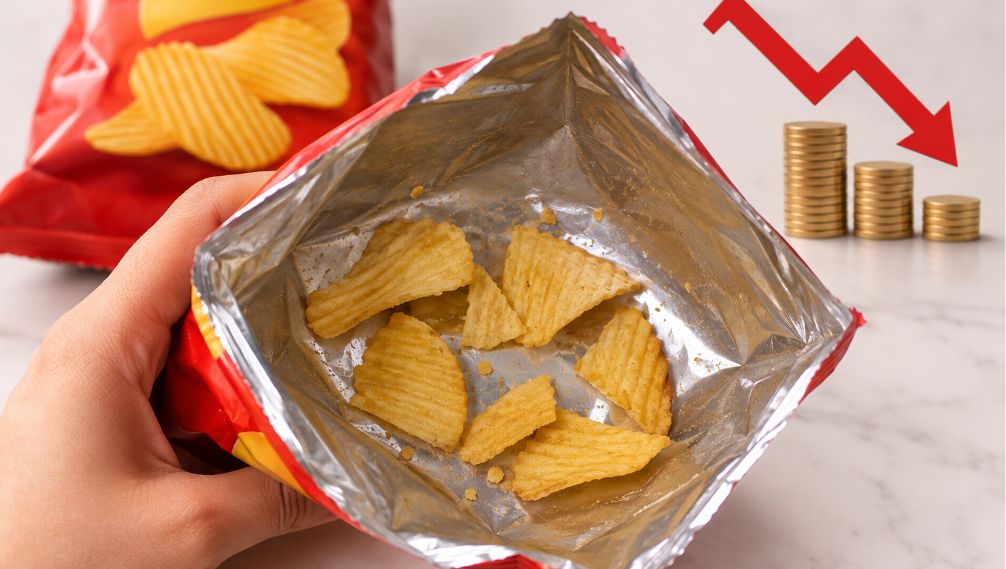
“Reducing grammage is a dangerous strategy. There comes a point where you open a pack and find only five broken chips inside. You can’t defend a price point that’s fundamentally unviable.”
The observation captures the central strategic problem.
A low price may preserve accessibility, but accessibility loses meaning when the quantity or experience no longer delivers credible consumer value.
Why the ₹5 Snack Pack Matters
Small packs play an important role in India’s packaged-food economy.
They allow consumers to purchase branded products without committing to a larger outlay. They also support trial, impulse consumption and frequent purchases through neighborhood stores.
For snack manufacturers, the ₹5 pack can function as:
According to the Mint report, ₹5 and ₹10 packs account for a substantial share of sales volume across biscuits and snacks. Several manufacturers remain highly dependent on the value segment.
This makes any change to the ₹5 proposition commercially sensitive.
Increasing the price may affect demand. Reducing quantity may weaken perceived value. Reducing retailer margins can affect visibility and recommendation at neighborhood stores.
The brand must manage all three relationships simultaneously: the consumer, the retailer and the product’s underlying economics.
The Economics Are Becoming Unforgiving
A ₹5 pack leaves very little room for cost absorption.
The Mint article breaks down the economics of an entry-level potato-wafer pouch. From the ₹5 selling price, a significant proportion is allocated to raw ingredients, packaging, freight, taxes, retailer and distributor margins, and factory operating expenses.
The manufacturer may ultimately retain only a small amount as net profit.
When potatoes, edible oil or plastic film become more expensive, even a modest increase can materially affect the residual margin.
The difficulty is compounded because the selling price cannot increase incrementally in the way input costs do.
A manufacturer cannot easily move a ₹5 pack to ₹5.30 or ₹5.75 in traditional retail. Familiar price points are important for purchase convenience, cash transactions and consumer expectations.
This leaves brands with a limited set of options: absorb the cost, reduce quantity, redesign the pack, adjust trade margins, change the price point or encourage consumers toward larger packs.
None of these choices is cost-free.
Grammage Reduction Has Reached Its Practical Limit
For several years, snack brands have protected affordable price points by reducing the amount of product inside the pack.
The approach allows companies to maintain the visible price while responding to increases in ingredients, packaging and distribution costs.
But the strategy has clear limits.
If the quantity becomes too small, the consumer no longer experiences the pack as an affordable purchase. The consumer experiences it as poor value.
This distinction matters.
A ₹5 pack may remain technically accessible, but it can lose commercial credibility when the amount inside no longer satisfies the consumption occasion.
Repeated grammage reduction can create several risks:
The decision should therefore not be based solely on whether another gram can be removed.
It should be based on whether the remaining product still delivers a legitimate experience at that price point.
Pack Engineering Can Reduce Costs Without Reducing the Product
Manufacturers are also redesigning packaging to use less material without changing the product quantity.
Smaller sealing areas, narrower pouches and more efficient dimensions can reduce plastic-film consumption. Even small savings may become meaningful when multiplied across millions of packs.
This is a more attractive route than repeatedly reducing grammage because it focuses on packaging efficiency rather than the edible product.
However, pack engineering must remain technically disciplined.
A redesigned pouch still needs to protect the product from moisture, contamination and breakage. It must remain compatible with packaging equipment, support efficient distribution and carry all required information.
The objective should not be to use the least possible material.
It should be to use the optimum amount of material needed to protect the product and deliver it efficiently.
Retailer Margins Influence What Consumers See
Traditional retail remains central to the small-pack snack market.
Neighborhood retailers decide which products receive visibility, which brands are recommended and how much stock is carried.
Some manufacturers are adjusting trade margins to make larger packs more attractive to retailers. If a retailer earns more from selling a ₹10 or ₹20 pack, the retailer may naturally encourage the consumer to move away from ₹5 purchases.
This approach can help brands improve average selling prices and protect margins.
But it carries a risk.
Reducing the retailer’s incentive on ₹5 packs too aggressively may weaken the brand’s visibility in the very outlets where value-conscious consumers shop.
Trade-margin redesign must therefore be approached carefully. The aim should be to encourage trade-up without making the entry product commercially unattractive to the retailer.
Brands need to assess the complete role of each pack size within the channel.
The ₹5 pack may deliver limited direct profit while supporting trial, availability and brand penetration. Larger packs may provide stronger absolute margins and better retailer economics.
The portfolio should allow these roles to reinforce each other.
Larger Packs Need a Clear Consumer Benefit
Moving consumers from ₹5 packs toward ₹10, ₹20 or larger formats cannot depend only on retailer recommendation.
The consumer needs to understand the benefit of spending more.
That benefit may come through:
If a larger pack simply increases the consumer’s immediate outlay without offering a visible advantage, the transition may remain limited.
The challenge is particularly important in price-sensitive markets, where ₹5 continues to function as a manageable and familiar purchase threshold.
Brands need to preserve entry-level accessibility while providing a credible reason to trade up.
Quick Commerce Favors Different Pack Economics
Quick commerce is adding another dimension to snack-pack strategy.
Very small, low-value orders can be difficult to justify against the costs of picking, packing and last-mile delivery. Rapid-delivery platforms therefore have a stronger incentive to promote mid-sized or larger packs that contribute to higher basket values.
This can support premiumization and pack-size migration among urban consumers.
But the quick-commerce consumer and the traditional-retail consumer do not always have the same needs.
A quick-commerce shopper may be purchasing for in-home consumption, social occasions or pantry stocking. A consumer buying from a neighborhood store may be seeking immediate consumption at the lowest available price.
Brands should therefore resist applying one pack architecture uniformly across channels.
Traditional retail may continue to require accessible single-consumption packs. Quick commerce and modern trade can support larger formats, bundles, multipacks and premium variants.
The strongest strategy will align pack size, price and occasion with the economics of each channel.
Premiumization Is Not a Universal Solution
Snack manufacturers are also expanding premium offerings through new flavors, healthier formulations and larger packs.
Premium ranges can help increase average selling prices and create more margin headroom.
However, premiumization should not be mistaken for a replacement for the mass market.
India’s snack category continues to depend heavily on consumers who are highly sensitive to price. Sustainable volume growth requires products that remain accessible.
As Arvind Singhal notes in the report:
“Sustainable volume growth only happens when pricing stays accessible.”
Premium offerings and accessible products therefore need to coexist.
A company may use premium products to generate margin and innovation while preserving an entry-level proposition for reach and recruitment.
The strategic task is to design a portfolio in which each price tier serves a clear consumer and commercial role.
The ₹5 Question Is Ultimately About Consumer Trust
Price points are powerful because consumers understand what they represent.
A ₹5 product communicates accessibility, familiarity and low purchase risk.
But if the product experience deteriorates while the price remains unchanged, the apparent stability can become misleading.
Consumers may not know the exact grammage reduction, but they recognize when a pack feels lighter, contains fewer usable pieces or offers less satisfaction than before.
This creates a trust issue.
Brands need to determine when preserving a familiar price point remains consumer-friendly and when it begins to damage the proposition.
Transparent value is more sustainable than a price point maintained through repeated and increasingly visible compromises.
#TKCPerspective: Five Priorities for Snack Brands
Establish the lowest quantity and product quality that can still deliver a credible consumption occasion.
Prioritize technical packaging efficiencies that preserve grammage, product protection and shelf life.
Use different pack sizes, bundles and price points for traditional retail, modern trade and quick commerce.
Manage trade margins carefully so that larger packs become attractive without undermining the visibility of entry products.
Maintain affordable entry points while building credible trade-up options and differentiated premium products.
How TKC Supports Packaged-Food and FMCG Businesses
The Knowledge Company works with packaged-food, snack and FMCG businesses to improve commercial resilience and profitable growth.
Pack-Price Architecture
Designing pack sizes, price points and portfolio roles around consumer needs, channel economics and margin requirements.
Category and Portfolio Strategy
Clarifying the roles of entry, mainstream and premium products within the category.
Consumer and Market Insights
Understanding price sensitivity, consumption occasions, value perceptions and willingness to trade up.
Channel and Distribution Strategy
Aligning packs, promotions and trade margins with traditional retail, modern trade, e-commerce and quick-commerce requirements.
Cost and Performance Improvement
Identifying opportunities across packaging, sourcing, manufacturing, assortment and supply-chain efficiency.
From a Familiar Price Point to a Sustainable Proposition
The ₹5 snack pack remains commercially and socially important.
It gives consumers a low-risk route into branded packaged food and supports distribution across India’s fragmented retail market.
But the price point cannot be protected indefinitely through smaller quantities.
Once the product becomes too insubstantial, the proposition stops delivering the value that made the pack successful.
Snack manufacturers need a more balanced response involving pack engineering, portfolio redesign, channel-specific formats, retailer economics and selective price action.
The central principle is straightforward:
Accessibility matters, but it must remain credible. A low price point creates sustainable growth only when the product inside continues to justify the purchase.
Reassessing your pack-price architecture, channel strategy or product economics?
Connect with TKC’s Retail, Consumer Goods & Food Advisory team at vidya@tkc.in.
Read Sowmya Ramasubramanian’s complete article in Mint: https://www.livemint.com/economy/snack-makers-tweak-trade-margins-engineer-pouches-to-break-5-pack-habit-11793688078298.html
Get the strategy behind the retail headlines. Subscribe to TKC’s free newsletter:
https://lnkd.in/eh-_58pf