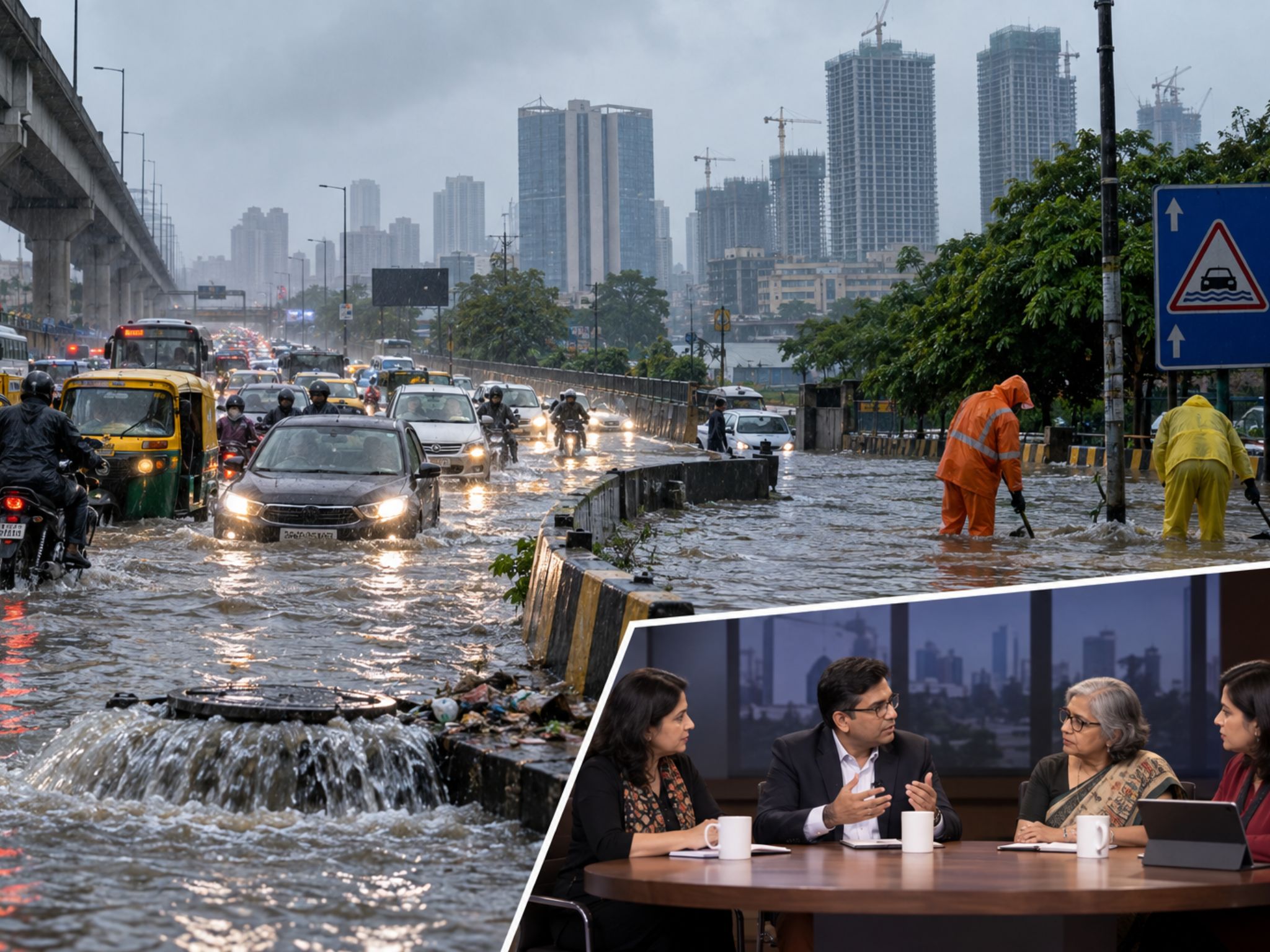
Every year, the monsoon season exposes the deep vulnerability of India’s urban spaces.
From waterlogged highways to collapsed drainage networks, the recurring disruptions in major commercial hubs raise a fundamental question: why are even our newest, most modern cities failing to handle basic weather events?
Joined by transparency activist Anjali Bhardwaj and development economist Dipa Sinha on The Wire, Ankur Bisen, Senior Partner at The Knowledge Company (TKC), delivered a detailed analysis of India’s urban planning crisis.
Host Jahnavi Sen led the discussion exploring why short-term administrative fixes continue to fall short.
Watch the full discussion at: https://www.youtube.com/watch?v=P2KJAneYM28
The Gurugram Paradigm: A Blank Canvas Lost to Poor Design
Gurugram is often cited as a modern economic marvel, yet it serves as an extreme case study of flawed urbanism.
Unlike legacy metropolitan centers burdened by historical density, Gurugram was built from scratch on barren land starting in the late 1990s.
Ankur Bisen emphasizes that because the city was planned on a clean slate, there are no structural excuses for its current infrastructure deficits:
- Destruction of Natural Gradients: Over 200 natural water bodies and wetlands were appropriated for real estate development, disrupting natural drainage paths without constructing graded stormwater alternatives.
- Misallocated Municipal Capital: While municipal bodies command substantial sanitation and maintenance budgets, a disproportionate share is absorbed by salaries and administrative overhead, leaving inadequate capital to manage single-use plastics and waste that choke drainage channels.
Replicating Failure Across Expanding Metros
Gurugram is not an isolated anomaly; it represents a “perfect storm” of a template being actively replicated across expanding urban centers such as Pune and Hyderabad.
The core issue lies in how governance structures view urban challenges. Rather than questioning the underlying city development model, public expectations are placed on short-term administrative leadership to manage systemic breakdowns.
Furthermore, both citizens and policymakers tend to view infrastructure failures as “episodic events”, generating intense outrage during peak monsoon weeks, only to revert to business as usual once the water recedes.
The Roadmap for Structural Urban Reform
Fixing India’s urban crisis requires moving away from reactive “band-aid” interventions toward enforceable, long-term governance frameworks:
- Enforceable Development Guardrails: Implementing strict, non-negotiable planning standards for both new developments and urban redevelopment projects to protect natural hydrology.
- Rebuilding Informal Living & Affordable Housing: Over 40% of urban India resides in slums and informal settlements. The withdrawal of state-backed affordable housing leaves massive populations vulnerable to extreme heat, poor sanitation, and economic disruption.
- Institutionalizing Sanitation Infrastructure: Currently, 65% of urban India lacks a dedicated sewage network. Establishing autonomous “Sanitation Boards”, with common minimum standards akin to state electricity or water boards, would ensure long-term capital allocation and professional oversight.
Acknowledging the true scale of this challenge is the mandatory first step toward building climate-resilient, economically viable Indian cities.
Strategic Transformation: How TKC Empowers Real Estate & Urban Infrastructure
Creating sustainable, resilient urban spaces requires integrating economic feasibility, spatial planning, and policy foresight.
The Knowledge Company (TKC) assists real estate developers, municipal bodies, and infrastructure conglomerates in building future-ready urban strategy through specialized advisory:
- Urban Real Estate & Infrastructure Feasibility: Assessing master plans, commercial viability, and land-use strategies to align private development with broader civic infrastructure.
- ESG & Climate-Resilient Spatial Strategy: Advising developers and municipal stakeholders on resource neutrality, flood mitigation, and sustainable materials.
- Public-Private Partnership (PPP) Frameworks: Structuring collaborative development models between private capital, institutional investors, and urban local bodies.
- Commercial & Mixed-Use Master Planning: Designing vibrant urban hubs that integrate retail, services, and public spaces to ensure long-term footfall and community utility.
Is your real estate or urban development strategy built for long-term climate resilience?
To discuss spatial strategy and infrastructure advisory with TKC’s team, connect with us at vidya@tkc.in.
Get the strategy behind the retail headlines. Subscribe to our free newsletter: https://lnkd.in/eh-_58pf
https://www.youtube.com/watch?v=P2KJAneYM28
Ankur Bisen joins Jahnavi Sen, Anjali Bhardwaj, and Dipa Sinha to discuss India’s urban infrastructure failures, the National Population Register, and key economic trends.