For years, India’s online food delivery sector has been a relatively straightforward battle for market share between two dominant incumbents: Swiggy and Zomato. However, fresh challengers, bold startup expansions, and shifting business models are rapidly redrawing the battle lines.
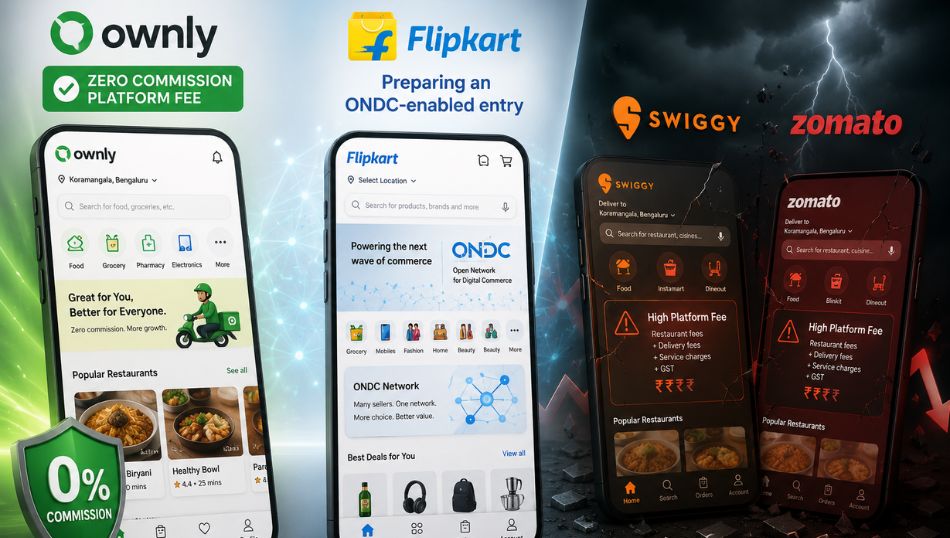
As highlighted in a recent Moneycontrol feature, new entrants like Rapido (with its zero-commission platform, Ownly) and Flipkart (launching via the ONDC network) are aggressively entering the fray. Meanwhile, Swiggy is scaling its value-focused “Toing,” and Zomato’s parent company is expanding affordable food bets through “Bistro.”
But amid this flurry of activity, a critical question remains: Is the market actually getting bigger, or are more players just fighting for the same slice?
The Stagnating Pie
Despite India boasting a massive base of internet users and digital payment adopters, the frequency of online food ordering remains surprisingly limited.
Providing strategic context to this market reality in Moneycontrol, Ankur Bisen, Senior Partner at The Knowledge Company (TKC), explains:
“The overall pie isn’t growing as fast as anticipated, so companies are essentially eating into each other’s share.”
Currently, much of the industry’s promotional capital is being spent to incentivize brand-switching among existing urban users. To build a sustainable, long-term business, the focus must shift from cannibalizing competitors to genuine category creation.
Unlocking the Next 100 Million Users
Industry leaders agree that food delivery must shed its “luxury” tag to achieve scale. The benchmark is clear: acquiring the next 100 million online food-ordering users within the next three years. However, platforms are fundamentally divided on how to achieve this:
- The Challenger Playbook (Zero-Commission & Value): Platforms like Rapido and Flipkart are leaning heavily on low consumer prices and zero-commission models for restaurants to aggressively acquire market share.
- The Incumbent Playbook (Structural Innovation): Established players argue that zero-commission economics are unsustainable in the long run. Instead, they believe that true affordability requires deep supply-chain innovation—including purpose-built kitchens, optimized workflows, and automation.
Shifting Leverage for Restaurants
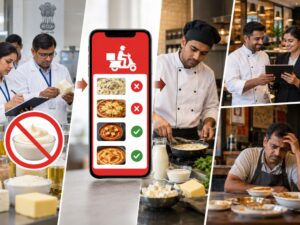
As competition intensifies, restaurants are emerging as the biggest potential winners. For years, food operators have struggled with thin margins, noting that platform costs extend far beyond basic commissions to include mandatory advertising, discounting, and visibility expenses.
With Rapido and Flipkart offering alternative channels, restaurants are gaining unprecedented negotiating leverage. If new platforms can successfully improve restaurant economics, those savings could ultimately be passed down to the consumer, further fueling the drive for affordability.
Strategic Transformation: How TKC Empowers F&B and Consumer Businesses
Navigating hyper-competitive consumer markets requires moving beyond aggressive discounting toward structural efficiency and deep market intelligence. The Knowledge Company (TKC) helps food service operators, retail conglomerates, and digital platforms build resilient growth engines for long-term profitability through specialized advisory:
- Unit Economics & Platform Strategy: Evaluating commission structures, platform fees, and margin sustainability across major marketplaces and quick-commerce channels.
- Alternative Channel Expansion: Designing strategies for ONDC integration, zero-commission platforms, and direct-to-consumer fulfillment to reduce single-channel dependence.
- Supply Chain & Kitchen Optimization: Advising on purpose-built kitchen workflows, dark store economics, and technology integration for high-efficiency fulfillment.
- Tier-2 & Tier-3 Market Entry: Structuring value-focused pricing and consumer propositions to acquire and retain non-metro digital consumers.
Is your retail or F&B strategy built for sustainable growth?
To discuss your market expansion roadmap with TKC’s advisory team, connect with us at vidya@tkc.in.
Get the strategy behind the retail headlines. Subscribe to our free newsletter: https://lnkd.in/eh-_58pf