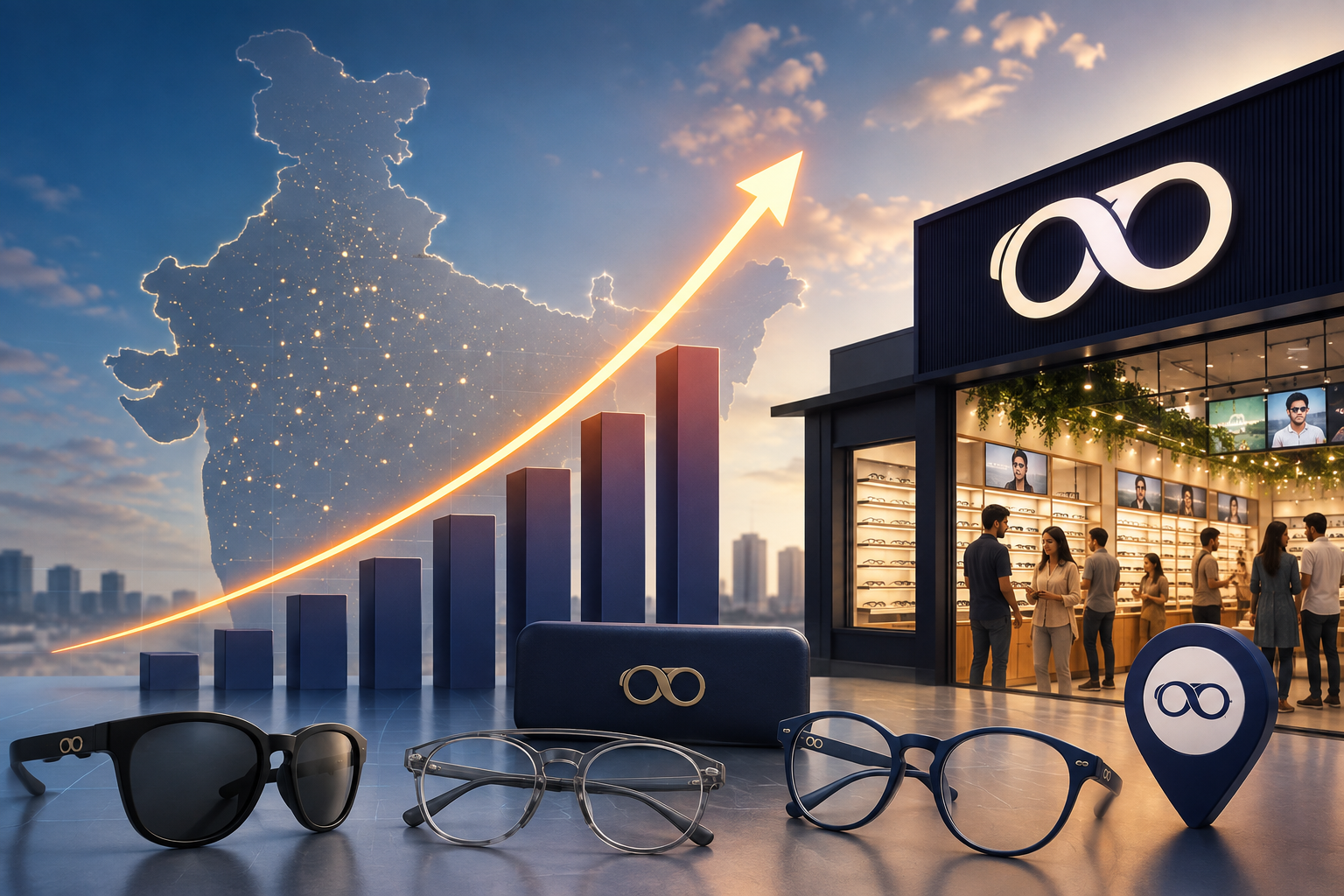
India’s organized eyewear market is currently experiencing explosive growth, projected by industry analysts to expand from $9.2 billion in FY25 to $17.2 billion by FY30. At the very forefront of this category creation is Lenskart Solutions, a brand that has completely redefined how Indians purchase vision care.
A recent Forbes feature highlights this incredible trajectory, noting that co-founder and CEO Peyush Bansal has officially joined the billionaire ranks following the company’s robust post-IPO performance and massive international expansion.
But behind the soaring market cap and rapid store rollouts lies a meticulously crafted operating model that has allowed Lenskart to outpace legacy competitors.
The Strategic Pivot to Physical Retail
Lenskart initially disrupted the market in 2010 as a digital-first platform offering 3D virtual try-ons. However, leadership quickly realized that while digital channels are excellent for discovery and repeat purchases, the deeply personal nature of eyewear requires a physical touchpoint.
Providing strategic context in Forbes, Arvind Singhal, Chairman at The Knowledge Company (TKC), explains why this offline transition was critical to their success:
“Buying spectacles is not an easy decision. You want the opinion of a family member or a friend and you want to look at a wide assortment. It is good that Lenskart corrected course and opened physical stores.”
Today, Lenskart operates over 3,450 stores across 16 countries. By bridging the gap between digital convenience and physical trust, they unlocked massive scale, proving that true retail dominance requires a seamless omnichannel presence.
Backward Integration: The Ultimate Competitive Moat
While an expansive retail footprint drives top-line revenue, Lenskart’s bottom-line profitability (which saw a four-fold rise to 2.28 billion rupees in the recent quarter) is heavily driven by backward integration.
Rather than relying purely on third-party vendors, Lenskart took control of its supply chain. The company operates a massive lens manufacturing facility in Rajasthan, a joint venture for frames in China, and is currently building a 50-acre mega-factory in Hyderabad designed to produce 50 million pairs annually.
Highlighting this structural advantage to Forbes, Arvind Singhal noted:
“Lenskart’s business model is one of a kind. Even Titan has not been able to do what the company has done in terms of the scale of manufacturing and the range that they offer.”
By marrying aggressive consumer acquisition with deep manufacturing capabilities, Lenskart has built a moat that allows for rapid product innovation, lower unit costs, and unmatched assortment depth.
Strategic Transformation: How TKC Empowers D2C & Retail Brands
Transitioning from a digital startup to a multi-billion dollar omnichannel powerhouse requires flawless execution across real estate, supply chain, and consumer experience. The Knowledge Company (TKC) helps D2C disruptors, legacy retailers, and global consumer brands build resilient, scalable operating models through specialized advisory:
- Omnichannel Architecture & Store Rollout: Designing profitable offline entry strategies for digital-first brands, optimizing store formats, and identifying high-conversion trade zones.
- Supply Chain & Backward Integration: Advising on manufacturing joint ventures, raw material sourcing strategies, and capacity planning to build structural cost advantages.
- Category Expansion Strategy: Utilizing deep market intelligence to help brands successfully enter adjacent categories (e.g., transitioning from prescription lenses to premium sunglasses and contact lenses).
- Global Market Entry: Formulating cross-border expansion playbooks and M&A integration strategies, ensuring localized relevance in international markets.
Is your retail strategy built to capture the next decade of consumer growth?
To discuss your omnichannel roadmap and supply chain transformation with TKC’s advisory team, connect with us at vidya@tkc.in.
Get the strategy behind the retail headlines. Subscribe to our free newsletter: https://lnkd.in/eh-_58pf