For the past few years, the food delivery and quick commerce (Q-commerce) sectors in India have operated on parallel tracks.
You ordered hot meals from one tab, and your groceries and packaged snacks from another. Today, those tracks are rapidly converging.
A recent feature in The Morning Context analyzed the rising tension in the 10-minute food delivery space, specifically looking at Bistro, the cloud kitchen venture under Eternal (the parent company of Zomato).
The article posed a critical question: Is Bistro simply Eternal’s reactive answer to emerging fast-snack startups like Toing and Ownly?
Read the full analysis in The Morning Context at: https://themorningcontext.com/internet/bistro-is-not-really-eternals-answer-to-toing-or-ownly
From a strategic consulting perspective, viewing this purely as a localized rivalry misses the larger operational picture.
Eternal has incorporated a wholly owned subsidiary, Blinkit Foods, specifically aimed at strengthening these food services operations.
This signals a massive structural shift in how delivery platforms view profitability.
Evaluating this ecosystem shift, Ravindra Yadav, Partner at The Knowledge Company (TKC), highlights that the integration of hot food into quick commerce is fundamentally a margin play rather than a mere defensive posture.
According to TKC’s analysis, platforms operating in Q-commerce face constant pressure on unit economics due to the thin margins of packaged goods.
By introducing 10- to 15-minute ready-to-eat options directly into localized dark stores, operators can boost average order values and capture high-margin impulse spend without driving up last-mile logistics costs.
- The Real Strategic Objective: A Margin Play
Startups like Toing and Ownly have certainly proven that a market exists for hyper-fast, snack-sized food deliveries.
However, an incumbent giant like Eternal does not restructure its operations simply to chase niche competitors.
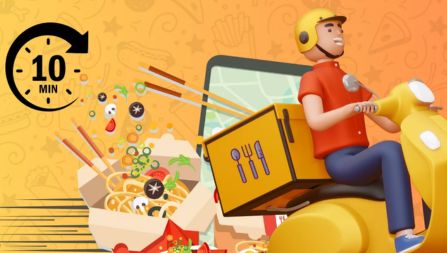
Bistro, which offers ready-to-eat meals, snacks, and beverages delivered within 10–15 minutes, is designed to solve one of the most persistent challenges in quick commerce: margin density.
Packaged groceries and FMCG products operate on notoriously thin margins. By contrast, prepared food and beverages (like a freshly brewed coffee or steamed momos) offer substantial gross margins.
When a customer adds a quick meal to their standard grocery basket, the overall profitability of that single 10-minute delivery run dramatically improves.
- Leveraging Infrastructure for Scale
To make 10-minute food delivery work without burning through capital, operators must leverage existing assets.
Bistro is currently operating dozens of kitchens across key urban hubs like Bengaluru and Delhi-NCR.
By layering these cloud kitchen capabilities over an already dense network of dark stores, Blinkit achieves multiple operational synergies:
- Maximized Real Estate: Utilizing the same localized real estate footprint to house both grocery inventory and quick-prep kitchen stations.
- Rider Utilization: Ensuring that the last-mile delivery fleet is constantly utilized across both standard quick commerce orders and high-frequency food orders.
- Unified Customer Acquisition: Cross-selling hot food to millions of users who are already opening the app multiple times a week for daily essentials.
- The Future: A Consolidated Convenience Basket
As Q-commerce players chase deeper profitability, the definition of the “convenience basket” is permanently expanding.
Consumers increasingly expect hygienic, high-quality, and responsibly sourced meals to arrive just as fast as their household supplies.
Standalone micro-kitchens will struggle to compete with the sheer distribution muscle and cross-category appeal of integrated platforms like Blinkit.
The food service operators of tomorrow must recognize that they are no longer just competing with the restaurant down the street, they are competing with the localized dark store that can deliver a hot meal alongside a week’s worth of groceries in under 15 minutes.
Future-Proof Your Food Services Strategy with TKC
The Knowledge Company’s Food Services Advisory practice works alongside leading restaurant chains, QSRs, and food-tech platforms to navigate the rapid convergence of cloud kitchens and quick commerce.
- Format and Channel Strategy: We help brands determine how to integrate their offerings into emerging rapid-delivery ecosystems.
- Unit Economics Optimization: Assisting operators in engineering menus and supply chains that protect margins in a high-speed delivery environment.
- Omnichannel Growth Blueprints: Building resilient footprints that balance physical brand equity with high-efficiency digital distribution.
Is your operational model ready for the 10-minute food revolution?
Connect with TKC’s Food Services Advisory Team at vidya@tkc.in to bring commercial clarity to your strategic roadmap today.