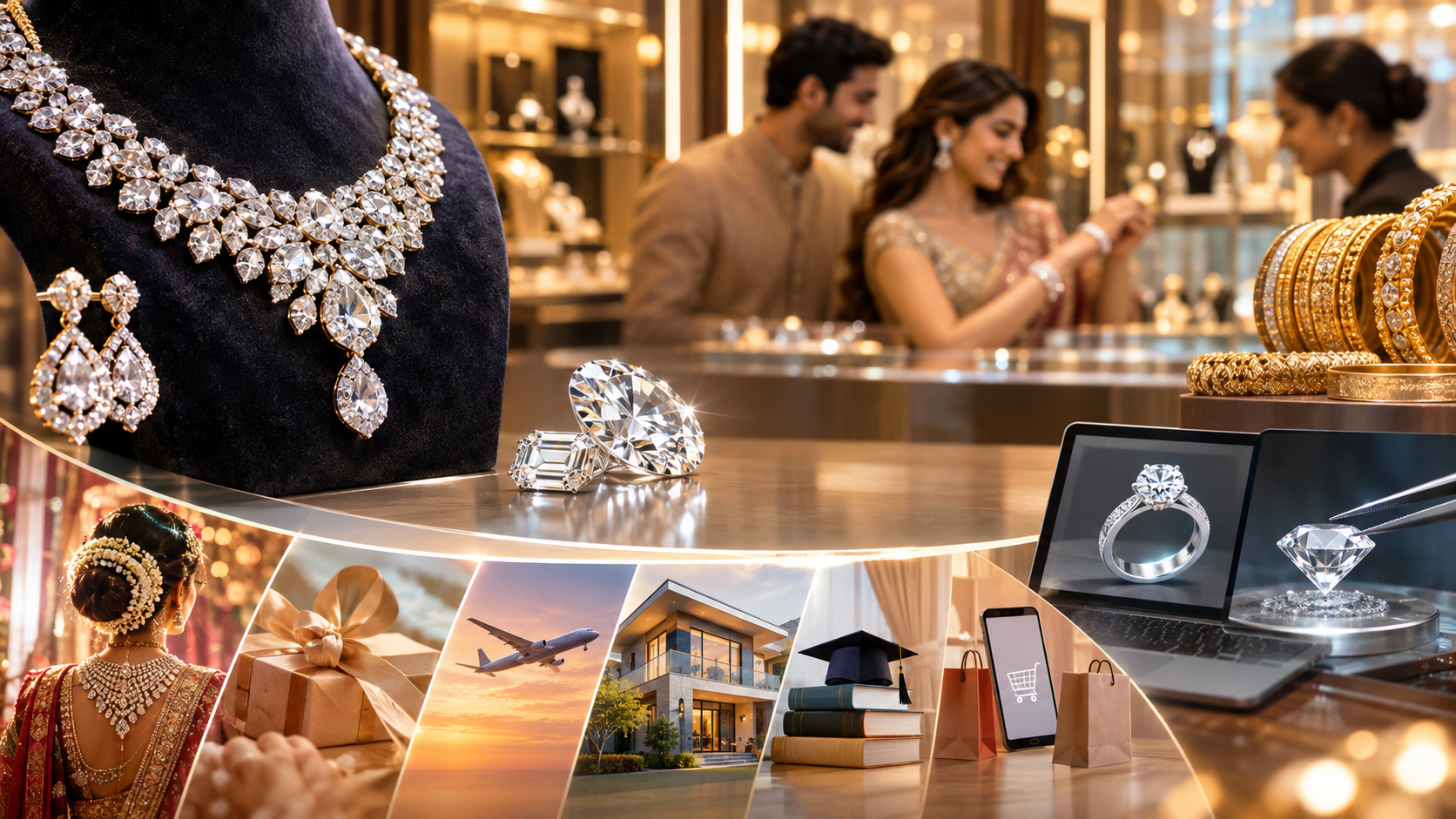
India’s natural diamond jewellery market is growing again.
According to the 2025 De Beers India Diamond Acquisition Study cited in India Today, India now accounts for 12% of global natural diamond jewellery demand, making it the world’s second-largest market after the United States.
The market, estimated at ₹78,500 crore in 2024, is projected to reach approximately ₹1.52 lakh crore by 2030. However, the growth story comes with an important caveat: much of the demand continues to come from a relatively small group of affluent repeat buyers.
In “The Natural Diamonds Revival,” written by Jumana Shah for India Today, Arvind Singhal, Chairman and Managing Director of The Knowledge Company (TKC), questions whether natural diamonds can achieve significantly broader penetration across India’s consumer base.
India’s Diamond Story Is Different from Its Gold Story
The rise of natural diamonds is frequently analyzed through the lens of luxury consumption, aspiration, and rising incomes.
However, India’s relationship with jewellery has historically been shaped by gold.
Unlike diamonds, gold combines adornment with saving, gifting, wealth preservation, and financial security. This multi-functional role has helped gold retain a privileged position across income groups, geographies, and generations.
As Arvind Singhal notes:
“Indian jewellery has historically used a very wide range of stones, semi-precious and precious, combined with silver, gold or platinum. Diamonds were never an asset class the way gold is.”
This distinction remains important because it influences how consumers evaluate value.
For many households, jewellery purchases are not only aesthetic decisions. They are also financial decisions.
Ownership Is Rising, But Purchase Frequency Is Not
One of the most revealing findings highlighted in the India Today report is that natural diamond ownership is increasing, while annual purchasing remains largely unchanged.
This suggests that many consumers are entering the category once but not returning frequently.
That pattern creates a challenge for brands.
A category can continue expanding through first-time buyers for only so long. Long-term growth depends on encouraging additional purchases, generating new usage occasions, and maintaining relevance beyond milestone events such as weddings and engagements.
The industry’s current focus on self-purchase occasions, gifting, friendships, and life-stage celebrations reflects an attempt to broaden the category’s role in consumers’ lives.
Lab-Grown Diamonds Are Changing Consumer Economics
The rapid rise of lab-grown diamonds has fundamentally altered the economics of jewellery purchasing.
For many consumers, particularly younger buyers, the primary attraction of diamonds has always been appearance rather than rarity.
That creates a challenge for natural diamond brands because lab-grown alternatives provide a visually similar outcome at significantly lower prices.
As Arvind Singhal observes:
“Lab-grown diamonds serve the purpose of adornment, and the average person can’t tell the difference.”
This does not mean that natural diamonds will disappear.
It does mean that consumers increasingly evaluate both options through different value frameworks.
Natural diamonds compete through rarity, heritage, emotional significance, and provenance.
Lab-grown diamonds compete through affordability, accessibility, and flexibility.
Both propositions can coexist, but their audiences and purchase motivations will not always be identical.
Premium Growth Does Not Guarantee Wider Penetration
The industry’s recent growth has been supported by affluent consumers purchasing new collections and higher-value products.
That growth is positive, but it does not necessarily indicate deeper category penetration.
A market fueled primarily by existing buyers can continue growing while remaining relatively narrow.
The larger opportunity lies with India’s substantial aspirational middle class, where jewellery purchases are often weighed against competing priorities, including housing, education, travel, savings, and gold accumulation.
The challenge is therefore not simply increasing awareness.
It is making natural diamonds relevant enough to justify repeat purchase behavior.
The Real Competitive Battle
Much of the industry discussion focuses on natural diamonds versus lab-grown diamonds.
But India’s jewellery market suggests a more complex reality.
Natural diamonds face competition from:
- Gold
- Lab-grown diamonds
- Other precious and semi-precious stones
- Experiential spending
- Digital and lifestyle purchases
- Alternative luxury categories
The question is not only whether consumers prefer natural or lab-grown diamonds.
The larger question is how consumers allocate discretionary spending in an environment filled with choices.
This is where emotional positioning, product design, distribution, and branding become increasingly important.
#TKCPerspective: Five Questions for the Natural Diamond Industry
- Can the category create more purchase occasions beyond weddings and engagements?
- Can brands increase repeat purchasing rather than relying primarily on first-time buyers?
- How will natural diamonds coexist with rapidly growing lab-grown alternatives?
- Can the category remain aspirational without relying solely on rarity?
- What role can diamonds realistically play in a market where gold continues to dominate wealth preservation?
The answers will shape the next phase of industry growth.
How TKC Supports Retail and Luxury Businesses
The Knowledge Company works with retailers, luxury brands, investors, and consumer businesses across:
- Consumer and market intelligence
- Luxury and premiumization strategy
- Category growth assessment
- Consumer behavior and demand forecasting
- Market-entry and expansion strategy
- Brand and proposition development
The Future of India’s Diamond Market
Natural diamond jewellery has regained momentum in India.
The challenge now is whether that momentum can expand beyond affluent repeat buyers and become a broader consumer phenomenon.
The industry’s future may depend less on defending diamonds against lab-grown alternatives and more on creating compelling reasons for consumers to choose diamonds over other uses of discretionary spending.
The next stage of growth will not be determined solely by supply, rarity, or marketing. It will be determined by consumer relevance.
Evaluating luxury, jewellery, or premiumization opportunities?
Connect with TKC’s Retail & Consumer Goods Advisory team at vidya@tkc.in.