


India’s grocery market offers immense scale, rising urban incomes and increasingly sophisticated consumer demand.
However, market size alone does not guarantee that every established international retail format will translate successfully.
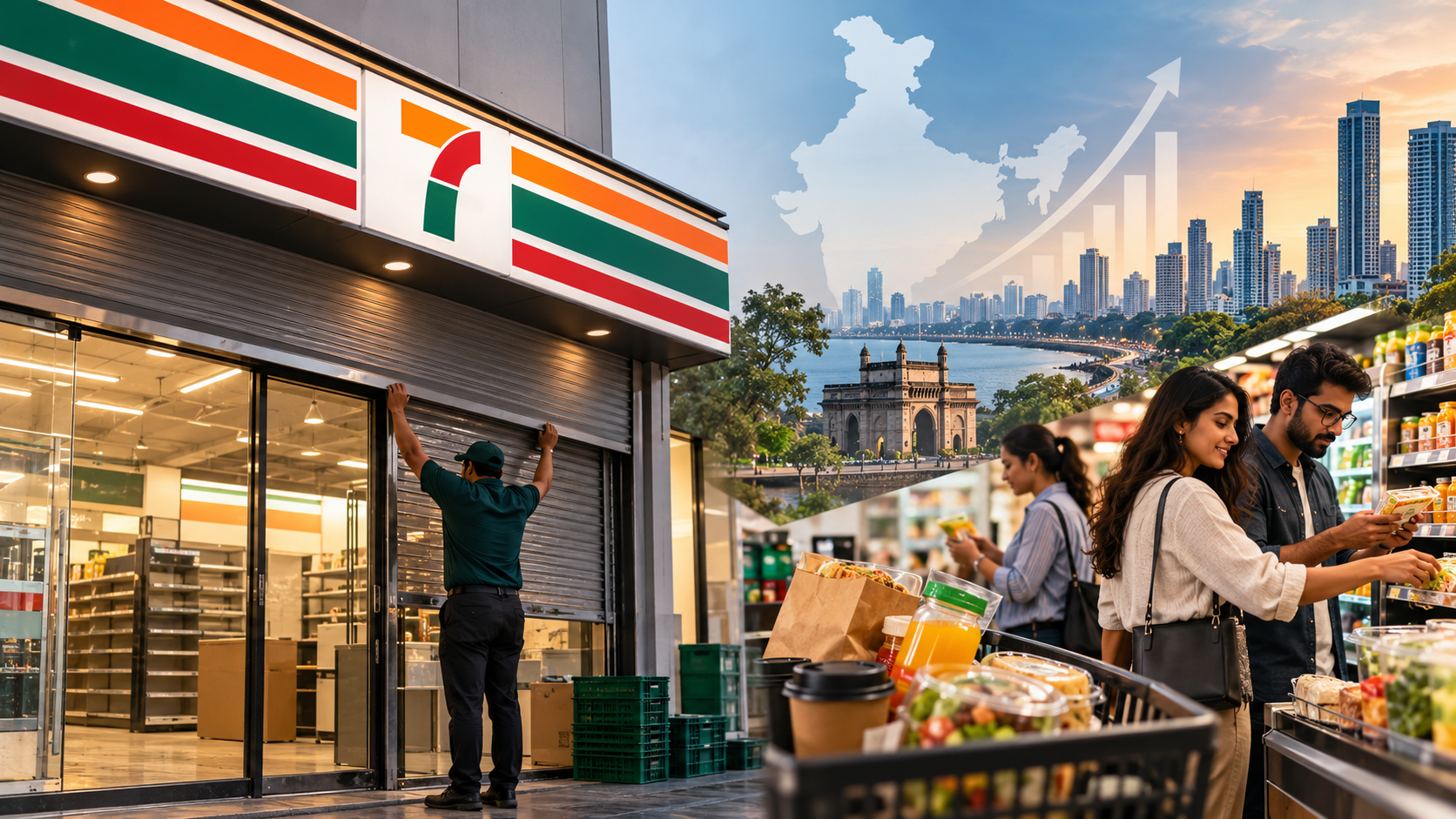
7-Eleven’s decision to close its Indian stores illustrates this distinction.
The company’s Indian master franchisee closed the remaining 31 stores in Mumbai and Pune on September 30, 2026. The closures came approximately five years after the brand opened its first Indian location in partnership with Reliance Retail.
In “7-Eleven’s India Exit Casts Shadow Over Lawson’s Expansion Plans,” published by Nikkei Asia, author Sayan Chakraborty examines what the exit could mean for other international convenience-store businesses entering India.
The question is particularly relevant for Lawson, which is preparing to enter the country while attempting to build a differentiated food-led and private-label proposition.
Providing a strategic perspective in the article, Arvind Singhal, Chairman and Managing Director at The Knowledge Company, explains how consumer behavior is changing the competitive environment:
“Quick-delivery is making a dent in urban India, particularly among the higher-end consumers, and the impact is being felt more by the large format supermarkets and grocery retailers. A lot of growth, which would have otherwise come to offline retailers, is actually going to quick deliveries.”
The implications extend beyond a single retailer.
India does not lack convenience. The market is already crowded with different and highly competitive forms of it.
Quick Commerce Has Redefined the Meaning of Convenience
Traditional convenience stores derive much of their value from proximity.
Consumers visit them because they are nearby, accessible for long hours and capable of fulfilling immediate or top-up requirements quickly.
Quick commerce has transformed that equation.
Consumers can now access groceries, packaged food, beverages, household essentials, electronics and personal-care products without traveling to a store. The relevant retail location is no longer necessarily the outlet closest to the consumer. It may be the dark store capable of delivering within minutes.
This creates a structural challenge for physical convenience retail.
A store must now offer more than geographic proximity because digital platforms can often provide:
For affluent urban consumers, especially those making smaller and more frequent purchases, rapid delivery can replace a significant proportion of routine store visits.
This does not mean that physical retail becomes irrelevant. It means that the purpose of the store must become clearer.
The Convenience Store Is Competing Against Several Formats
International retailers entering India do not compete against one uniform grocery channel.
They face a diverse retail ecosystem that includes:
Each solves a different consumer need.
Quick-commerce platforms compete on speed and digital convenience.
Large-format retailers compete on assortment breadth, pricing and planned stock-up purchases.
Regional supermarkets combine local familiarity with organized retail standards.
Kirana stores compete through proximity, relationships, flexible service, local assortments and, in some cases, informal credit.
Food-delivery platforms compete with the fresh-food and immediate-consumption element of the convenience-store proposition.
The competitive question is therefore not simply whether a convenience store can attract demand.
It is whether the store can solve a need more effectively than multiple alternatives that consumers already understand and use.
Why 7-Eleven’s Global Proposition Was Difficult to Replicate
In several international markets, 7-Eleven has developed a strong proposition around ready-to-eat food, beverages, snacks, daily essentials and around-the-clock availability.
That proposition enters a different context in India.
Prepared-food and snack occasions are already served by:
The brand therefore needed to offer a sufficiently differentiated combination of merchandise, food, service, pricing and convenience.
As Arvind Singhal observes, a smaller assortment also places a convenience store at a disadvantage against large national and regional retailers that offer groceries, daily essentials, cookware, stationery and other household products within one format.
A narrower assortment can succeed when the format owns a highly relevant consumption occasion. Without that distinct role, consumers may choose broader or faster alternatives.
Assortment Breadth Is Only One Part of the Problem
Expanding the range could make a store more useful, but it could also weaken its economics.
Each additional category introduces requirements around:
A convenience store cannot become a smaller supermarket without carefully considering what that means for its operating model.
The strategic objective should not be to maximize the number of products. It should be to build an assortment aligned with specific consumer missions.
These may include:
Each mission requires a different mix of food, beverages, household essentials and services.
A successful format needs to decide explicitly which missions it intends to own.
Foreign Branding Is No Longer Enough
International brands once benefited from strong novelty value in India.
Global identity could signal modernity, quality, aspiration or access to experiences not widely available through domestic retail.
That advantage has weakened.
Indian consumers now have access to international brands across fashion, food, beauty, electronics and entertainment. Domestic retailers have also improved store design, assortment, digital capabilities and customer experience.
A foreign name may attract initial curiosity, but it does not guarantee repeat visits.
Consumers are more likely to ask:
The brand’s origin is therefore less important than its local relevance.
Standardized Merchandise Has Limited Defensibility
Convenience formats frequently rely on standardized packaged merchandise that is available through several competing channels.
This creates price transparency and reduces the consumer’s reason to choose one retailer over another.
If the same beverage, snack or household product is available through a kirana store, supermarket and quick-commerce app, the store must compete through one or more of the following:
Without differentiation, the store becomes another point of availability rather than a compelling destination.
This is especially difficult when the consumer can obtain an identical product without leaving home.
Fresh Food Can Differentiate, but Localization Is Essential
Fresh and prepared food remains one potential source of differentiation for international convenience-store chains.
However, the category cannot simply be transferred from another market.
Successful localization requires attention to:
Products such as Japanese rice balls or oden may generate curiosity and attract niche demand. But discovery products alone may not create sufficient frequency for a scaled store network.
A sustainable fresh-food proposition needs a balance between distinctiveness and habitual relevance.
Consumers may experiment with international items occasionally, but store economics require repeatable daily demand.
Every Store Needs a Clear Visit Trigger
A fundamental question for any physical retail format is: Why should the consumer visit today?
The answer cannot be only that the store exists nearby.
A strong visit trigger may be:
The visit trigger must be relevant enough to overcome the convenience of ordering online.
It should also be frequent enough to support viable store economics.
A format built around occasional curiosity may generate initial footfall but struggle to create repeat behavior.
Catchment Economics Matter More Than National Ambition
Large national expansion targets can create momentum, but convenience-store economics are determined one catchment at a time.
Each location must generate sufficient demand to support:
A store in a dense business district serves different missions from one in a residential neighborhood, transport hub or educational area.
Expansion plans should therefore consider:
A high-growth city can still contain unsuitable catchments.
National opportunity does not remove the need for location-level discipline.
Physical and Digital Retail Must Work Together
A purely offline convenience-store strategy faces increasing risk in major Indian cities.
However, simply adding delivery does not create a complete omnichannel model.
The store network and digital channel must reinforce each other.
Physical stores can contribute:
Digital channels can contribute:
The key is to design the store as part of a connected retail and fulfillment system rather than as an isolated sales point.
Stores may need to function simultaneously as neighborhood outlets, prepared-food locations and local fulfillment nodes.
Private Labels Can Create Differentiation, but Also Concentration Risk
Lawson reportedly intends to begin its India presence with private-label products as part of its approach to navigating foreign-investment restrictions.
Private labels can help establish distinctiveness because the assortment is not directly comparable with merchandise available elsewhere.
They can also support:
However, an exclusively or heavily private-label proposition also creates risks.
Consumers may be unfamiliar with the products. The retailer must build trust across multiple categories simultaneously. Distribution is concentrated within the retailer’s own network, limiting external awareness and trial.
Private labels succeed when they solve a clear consumer need, deliver consistent value and build credibility over time.
Exclusivity alone is not enough.
Franchising Reduces Capital Exposure, Not Consumer Risk
Franchise and licensing arrangements can reduce the foreign retailer’s direct financial responsibility for stores.
But franchising does not remove the need for a viable consumer proposition.
The local operating partner still needs:
If the proposition is weak, transferring capital responsibility to a franchisee changes who absorbs the loss. It does not repair the business model.
International brands must therefore treat franchising as an operating structure, not as a substitute for market adaptation.
#TKCPerspective: What Lawson and Other Entrants Must Get Right
For international convenience-store businesses evaluating India, six priorities stand out.
The format must identify the specific occasions it can serve better than quick commerce, supermarkets, food-delivery platforms and kirana stores.
Fresh food, private labels and imported merchandise must be adapted to local tastes, dietary preferences, pricing and occasions.
Physical outlets should support rapid fulfillment and digital ordering rather than rely exclusively on walk-in traffic.
Standardized merchandise is widely available. Exclusive products and services must give consumers a reason to choose the format.
Expansion should follow evidence of repeat purchase, viable daypart demand and sustainable store-level contribution.
Supply chains, food preparation, quality controls, franchise governance and replenishment systems must support consistency as the network grows.
How TKC Supports International and Domestic Retailers
The Knowledge Company works with retailers, consumer brands, investors and market entrants to design commercially relevant India growth strategies.
Market Entry Strategy
Assessing market attractiveness, consumer opportunity, competitive conditions and suitable entry models.
Retail Format and Proposition Design
Defining target consumers, shopping missions, assortment, store roles and experience.
Catchment and Network Strategy
Prioritizing cities, micro-markets and locations using demand and store-economics analysis.
Omnichannel Strategy
Connecting physical stores, e-commerce, quick delivery and local fulfillment around clear customer missions.
Private-Label and Assortment Strategy
Developing differentiated portfolios, category roles, pricing ladders and localization plans.
Franchise and Operating-Model Design
Establishing governance, economics, capabilities and performance standards for scaled expansion.
India Needs a Different Definition of Convenience
7-Eleven’s India exit should not be interpreted as evidence that the country lacks a convenience-retail opportunity.
It shows that the definition of convenience is market-specific and rapidly changing.
In urban India, convenience may mean delivery in minutes. In neighborhood retail, it may mean personal familiarity, informal credit and immediate proximity. In organized supermarkets, it may mean assortment breadth and competitive pricing. In food delivery, it may mean access to prepared meals without travel.
An international convenience-store format must compete within all these definitions.
The opportunity remains substantial, but the successful model will not be a direct copy of a Japanese, Southeast Asian or Western store format.
It must create a distinctly Indian reason to visit, order and return.
Evaluating an India market entry, convenience-retail proposition or network strategy?
Connect with TKC’s Retail & Consumer Goods Advisory team at vidya@tkc.in.
Read Sayan Chakraborty’s complete article in Nikkei Asia:
7-Eleven’s India Exit Casts Shadow Over Lawson’s Expansion Plans
Get the strategy behind the retail headlines. Subscribe to TKC’s free newsletter: https://lnkd.in/eh-_58pf