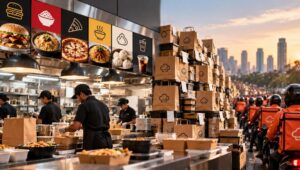



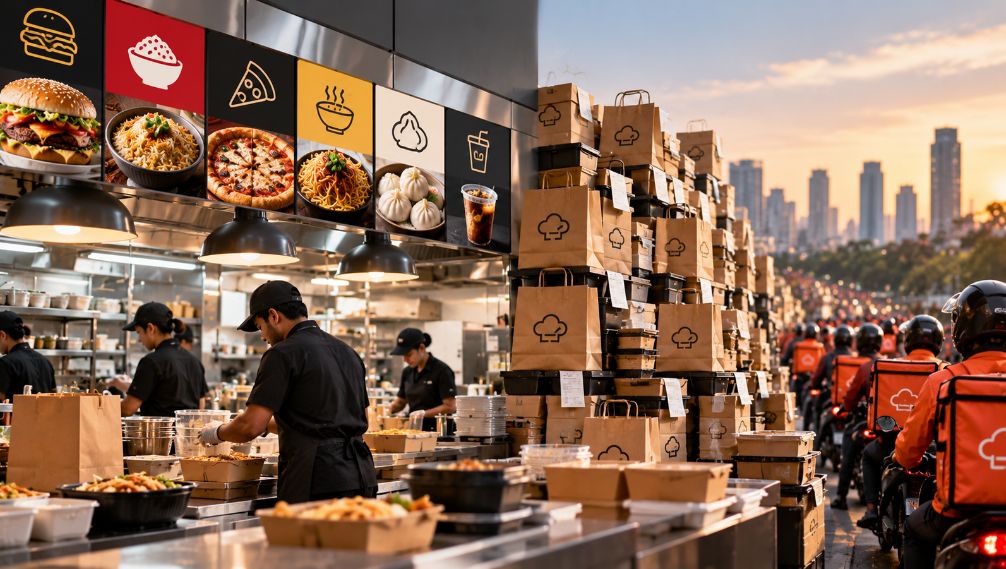
Rebel Foods has achieved something few foodservice businesses have managed: building a scaled cloud-kitchen platform across multiple brands and consumption occasions.
That scale has established the company as a distinctive player in India’s food-delivery ecosystem. It has also created the central strategic challenge confronting the business today.
In the The Morning Context article “Can Ankush Grover Take Rebel Foods to the IPO Finish Line?”, author Hiral Goyal examines the company’s effort to move from growth-led expansion toward profitability and an eventual public listing. The article reports that Rebel Foods generated ₹1,951.5 crore in operating revenue in FY26 while recording a net loss of ₹281.8 crore.
Providing a foodservice industry perspective, Ravindra Yadav, Partner, Retail & Food Services at The Knowledge Company, summarizes the strategic tension:
“No other company has managed to scale a cloud kitchen business with multiple brands like Rebel has. But the one thing that has brought so much growth to the company is also the one thing dragging it down.”
This observation raises a larger question for the cloud-kitchen sector: When does scale strengthen the business, and when does it begin adding more complexity than economic advantage?
The Difference Between Scale and Profitable Scale
Business scale is often measured through revenue, locations, brands, orders or geographic reach.
Profitable scale demands something more. Every additional unit of growth must improve, preserve or at least justify the economics of the wider network.
For a cloud-kitchen platform, expansion can create potential advantages:
But these benefits are not automatic.
A larger network also requires more accurate forecasting, stricter recipe controls, dependable procurement, better labor deployment and consistent kitchen-level execution. A broader brand portfolio can increase ingredient complexity, training requirements, marketing expenditure and inventory risk.
The real test is therefore not whether the platform can become larger. It is whether increasing scale makes the system more efficient.
The Economics Must Work at the Kitchen Level
A network cannot become sustainably profitable if only a small proportion of its kitchens operate efficiently.
Cloud kitchens need sufficient order density to use staff, equipment, ingredients and delivery capacity productively. A kitchen with inadequate demand may still incur rent, labor, utilities, maintenance and inventory costs, even when its physical footprint is smaller than that of a conventional restaurant.
The economics must ultimately work at the individual kitchen and catchment levels.
Management teams should have clear visibility into:
A profitable network is not created by averaging strong and weak kitchens together. It is created by identifying why performance differs and correcting, consolidating or exiting units that cannot achieve viable economics.
Brand Breadth Can Become Operational Complexity
The multi-brand model is central to the cloud-kitchen proposition.
A shared kitchen can serve different cuisines and consumption occasions under separate consumer-facing brands. In principle, this allows the operator to use the same infrastructure more effectively and capture a larger share of local food-delivery demand.
However, every additional brand must earn its place within the portfolio.
A brand adds value when it:
A brand adds complexity when it requires additional ingredients, training, marketing and operating processes without generating sufficient incremental value.
The strategic task is not to preserve the maximum number of brands. It is to identify which brands strengthen the shared platform and which have become expensive layers within it.
Portfolio rationalization should not be interpreted as a retreat from growth. It can be a necessary step toward concentrating capital and management attention on the brands with the strongest consumer proposition and most attractive economics.
Aggregator Reach Has a Commercial Price
Delivery platforms provide cloud-kitchen businesses with immediate access to consumers actively searching for food. They offer discovery, transaction infrastructure and delivery capability at a scale that would be expensive for individual brands to recreate.
That reach, however, comes at a cost.
The Morning Context reports that Rebel Foods spent ₹317.7 crore on brokerage and commissions in FY26, including payments associated with food-delivery aggregators. It also reports ₹53.5 crore in outsourced delivery expenditure.
The strategic issue is not whether aggregators are inherently beneficial or harmful. The issue is the degree of dependence.
A business that relies heavily on third-party platforms may gain access to demand but have limited ownership of the customer relationship. It may also face greater price comparison, weaker brand loyalty and recurring pressure to participate in promotions.
An owned platform offers more customer control, but it must independently generate traffic, conversion and repeat usage. It may also require the operator to support delivery capabilities or absorb higher customer-acquisition expenses.
Foodservice businesses therefore need to determine the correct role for each channel:
Channel diversification creates value only when each channel performs a clear commercial function.
Growth Should Improve Customer Economics
Cloud-kitchen growth is often evaluated through orders, kitchens and cities.
A stronger measure is whether the business becomes more economically efficient as its customer base expands.
If every incremental customer must be repeatedly acquired through discounts or paid visibility, scale may increase revenue without creating durable value.
Management teams should instead examine:
The objective should not be to eliminate marketing expenditure. It should be to ensure that marketing builds a consumer relationship whose lifetime value exceeds the cost of acquisition and fulfillment.
This is especially important in online food delivery, where consumers can compare multiple brands within seconds and switch on the basis of price, ratings or delivery time.
Why Physical Formats May Matter
The return to physical formats should not be viewed as an admission that the cloud-kitchen model has failed.
Online and offline formats solve different business and consumer needs.
Digital channels offer reach, flexibility and convenience. Physical locations can create visibility, facilitate product trial and give consumers a more tangible connection with the brand.
Ravindra Yadav told The Morning Context that a combination of online and offline may be necessary because loyalty to individual brands can be weak online, while customer acquisition and retention are becoming more expensive.
The strategic case for offline expansion must nevertheless be tested carefully.
A physical location should have a defined role. It may function as:
The appropriate format will vary by catchment and brand.
Offline expansion becomes problematic when it is pursued mainly for visibility without a clear path to store-level productivity. Rent, fit-out, staffing and maintenance can quickly replace aggregator commissions with a different category of fixed costs.
The goal is not to choose online over offline or vice versa. It is to build a format portfolio in which channels reinforce one another and improve the total economics of the customer relationship.
Standardization Is a Profitability Capability
In foodservice, small execution gaps become material when multiplied across hundreds of kitchens and thousands of daily orders.
Recipe variation can affect taste, portion size, food cost and consumer confidence. Inconsistent procurement may raise ingredient costs or create unnecessary waste. Uneven training can reduce productivity and increase the likelihood of operating errors.
Standardization supports:
However, standardization should not eliminate necessary local adaptation.
Menus, price points and consumption occasions can differ by market. The operating model must distinguish between what should remain uniform across the network and what should respond to local demand.
The discipline lies in controlling complexity rather than denying it.
Procurement Can Convert Scale into Leverage
A large network should create purchasing leverage, but this requires coordinated procurement and demand planning.
If brands and kitchens buy fragmented ingredient portfolios without sufficient forecast accuracy, the network can lose the benefits of its scale through excess stock, spoilage and inconsistent ordering.
Procurement advantage depends on:
Scale becomes commercially valuable when it improves the terms, reliability or efficiency of the supply base.
Without this coordination, a multi-brand network may generate purchasing complexity rather than purchasing power.
Profitable Adjacencies Must Strengthen the Core
Rebel Foods is pursuing opportunities beyond its original cloud-kitchen brands, including the expansion of Wendy’s and the development of physical formats under EatSure. The source article distinguishes between the results achieved by these initiatives, reporting stronger expansion for Wendy’s while describing a slower rollout of EatSure food courts.
For any platform business, adjacency decisions should be assessed against several questions:
Adjacencies can accelerate profitability when they use existing strengths more productively.
They can also become another source of complexity if they require separate capabilities, capital and management attention without materially strengthening the wider system.
A Practical Framework for Cloud-Kitchen Profitability
For cloud-kitchen platforms seeking sustainable growth, five disciplines are particularly important.
1. Kitchen-Level Economic Clarity
Every kitchen should have a defined route to viable contribution based on realistic order density, food costs, labor, marketing and delivery expenses.
2. Portfolio Discipline
Brands should be evaluated by their consumer relevance and economic contribution, not by the length of time they have existed within the portfolio.
3. Channel Purpose
Aggregators, owned apps, physical outlets and takeaway formats should each solve a distinct commercial or consumer problem.
4. Repeatable Operations
Recipe controls, training, procurement, production and quality standards must be executable consistently across the network.
5. Capital-Conscious Growth
Expansion should follow evidence of favorable unit economics. Revenue growth should not obscure the cash and management resources required to maintain additional complexity.
What Public-Market Readiness Requires
An IPO narrative needs more than market leadership and revenue growth.
Public-market investors generally require a credible understanding of:
For Rebel Foods, exceptional scale establishes strategic relevance. The next requirement is demonstrating that the model can produce disciplined, sustainable returns.
The strength of the IPO case will ultimately depend less on the number of kitchens or brands and more on evidence that the underlying economics are improving.
How TKC Supports Foodservice Businesses
The Knowledge Company works with QSRs, restaurant chains, cloud-kitchen platforms, food brands and investors to build growth models that are commercially differentiated and economically sustainable.
Portfolio and Brand Strategy
Evaluating brand roles, consumer propositions, category opportunities and portfolio rationalization priorities.
Unit Economics and Profitability Improvement
Identifying improvement opportunities across pricing, food costs, labor, marketing, delivery expenses and kitchen utilization.
Menu and Recipe Optimization
Strengthening menu architecture, recipe standardization, contribution margins and wastage controls.
Format and Channel Strategy
Defining the appropriate roles of cloud kitchens, physical restaurants, food courts, takeaway, delivery aggregators and owned digital channels.
Procurement and Supply-Chain Strategy
Improving ingredient sourcing, supplier structures, quality controls, inventory planning and purchasing efficiency.
Network and Expansion Strategy
Prioritizing markets, catchments and formats based on consumer demand, competitive conditions and unit-level economics.
Business Transformation
Aligning leadership priorities, operating processes, performance metrics and organizational capabilities around sustainable profitability.
From Growth Infrastructure to a Profitable Platform
Rebel Foods has already demonstrated that a multi-brand cloud-kitchen platform can achieve significant scale.
The next phase is more demanding.
The company must show that a growing network can generate better economics, not simply more revenue. It must turn a diverse portfolio into focused consumer propositions, shared infrastructure into operating leverage and multiple channels into stronger customer economics.
The central lesson extends beyond one company.
Scale does not become a moat merely because it is difficult to replicate. It becomes a moat when it consistently lowers costs, strengthens consumer relationships and improves returns.
That is the transition cloud-kitchen businesses must make: from adding kitchens, brands and orders to building a platform in which every layer of growth contributes to sustainable economic value.
Is your foodservice growth model translating scale into sustainable profitability?
Connect with TKC’s Food Services Advisory team at vidya@tkc.in to discuss portfolio strategy, unit economics, channel mix, procurement and operating-model transformation.
Read the complete original analysis by Hiral Goyal in The Morning Context: https://themorningcontext.com/internet/can-ankush-grover-take-rebel-foods-to-the-ipo-finish-line
Get the strategy behind the retail headlines. Subscribe to TKC’s free newsletter at: https://lnkd.in/eh-_58pf