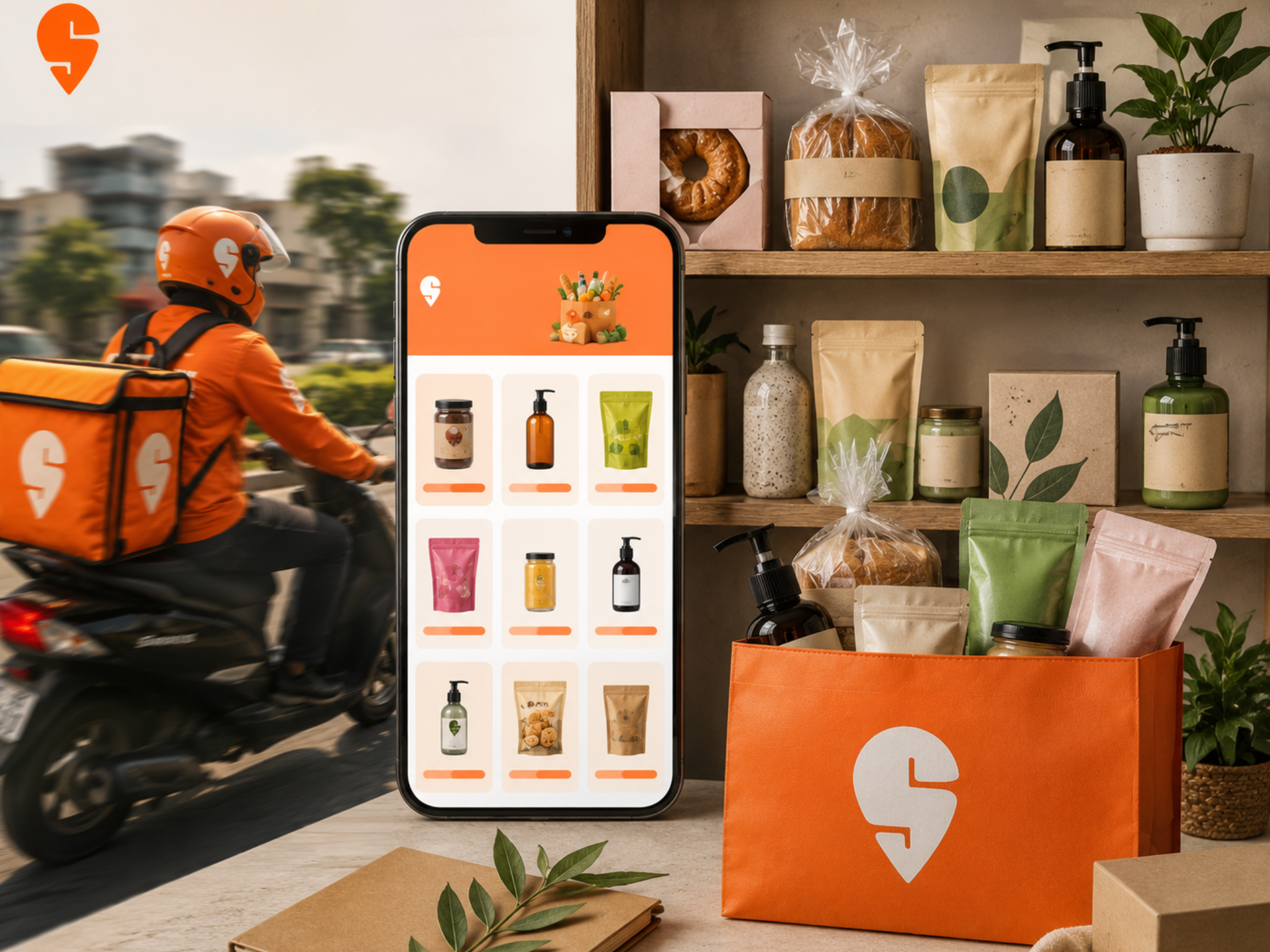
In India’s hyper-competitive quick-commerce landscape, delivery speed and baseline product selection are rapidly becoming commoditized.
With leading platforms fulfilling orders in 10 to 15 minutes across major urban centers, competing on fulfillment time alone yields diminishing returns.
To break away from interchangeable product catalogs, Swiggy Instamart is testing a new differentiation playbook.
Through initiatives like ‘Switch to Better,’ the platform is partnering with over 400 younger D2C brands, ranging from artisanal bakeries to eco-friendly homecare makers, to offer exclusive pack sizes, specialized formulations, and targeted alternatives that cannot be found on rival apps.
The Economics of D2C & Exclusive Packaging
For quick-commerce platforms trailing market leaders, curated assortment serves a dual financial purpose. By onboarding emerging challenger brands that offer premium, health-conscious, or niche items, platforms can expand their average order value (AOV) while tapping into higher brand ad spend.
Providing strategic clarity on this dynamic in Livemint Sowmya Ramasubramanian, Ankur Bisen, Senior Partner at The Knowledge Company (TKC), explains:
“Younger brands are useful to quick-commerce platforms not only because they tend to spend more on advertising, but also because their premium pricing can help drive larger basket sizes.”
For challenger brands, the partnership offers rapid trial and high visibility. For platforms, exclusive single-liter cleaning liquids or custom 90g spice packs create an environment where direct price comparison across apps becomes more difficult for the consumer.
Read the full feature on Livemint: https://www.livemint.com/companies/news/instamarts-new-bet-make-quick-commerce-products-harder-to-copy-11787808072981.html
The Copycat Trap and Consumer Friction
While tailored assortments provide an immediate point of difference, defending this advantage presents a long-term challenge. Legacy FMCG giants, whose products already dominate general and modern trade, have little incentive to create platform-exclusive SKUs.
Meanwhile, rival quick-commerce platforms can easily replicate the playbook by commissioning their own exclusive variants with competing D2C players.
Highlighting the fundamental consumer friction at play, Ankur Bisen urges caution regarding whether this initiative will fundamentally alter market share.
Ultimately, exclusive packaging acts as a gateway, but long-term customer retention depends on whether platforms deliver a holistic value proposition combining price, product quality, and platform reliability.
Strategic Transformation: How TKC Empowers Quick-Commerce & D2C Businesses
As quick commerce shifts from rapid expansion to margin defense and portfolio differentiation, platforms and consumer brands require data-driven commercial strategies.
The Knowledge Company (TKC) helps retail conglomerates, D2C brands, and digital marketplaces navigate channel economics through specialized advisory:
- Assortment & Category Architecture: Designing tailored SKU strategies and channel-exclusive packaging frameworks that maximize Average Order Value (AOV) without cannibalizing legacy channels.
- Quick-Commerce Channel Economics: Evaluating platform commission structures, dark store logistics, and trade spend to ensure sustainable contribution margins for emerging and established brands.
- D2C Scale & Partnership Playbooks: Helping challenger brands structure strategic alliances with quick-commerce platforms to secure maximum visibility and rapid market penetration.
- Consumer Loyalty & Value Perception: Analyzing micro-market consumer behavior to build pricing, promotion, and curation strategies that drive repeat purchases over app-switching.
Is your quick-commerce or D2C strategy built for sustainable, long-term differentiation?
To discuss your channel strategy and consumer intelligence roadmap with TKC’s advisory team, connect with us at vidya@tkc.in.
Get the strategy behind the retail headlines. Subscribe to our free newsletter: https://lnkd.in/eh-_58pf