



India’s packaged-food industry may be confronting a ₹1 lakh crore problem that remains largely invisible in boardroom discussions: products that expire because they cannot be sold within their permitted shelf life.
The Knowledge Company estimates that India consumes approximately ₹17 lakh crore of packaged food annually, much of it supplied by formal fast-moving consumer goods enterprises and organized food businesses.
TKC’s working analysis indicates that around 8% of this market may expire, translating into packaged food with an estimated retail value of approximately ₹1.3 lakh crore every year.
These estimates require industry-wide validation. Expiry levels are also unlikely to be uniform across businesses, categories, channels or regions.
Efficiently managed brands with strong demand forecasting, first-expire-first-out inventory rotation, disciplined distributor controls and responsive replenishment may contain expiry below 2% of sales. The wider industry average could potentially fall between 5% and 7%, while challenged businesses affected by inaccurate planning, excessive channel loading or weak distributor governance may experience expiry exceeding 20%.
Even at a conservative 5% of a ₹17 lakh crore packaged-food market, the retail value of expired inventory would approach ₹85,000 crore.
This does not mean manufacturers lose the entire retail value. The final financial impact depends on product cost, channel ownership, credit arrangements, material recovery and contractual responsibility.
Nevertheless, the scale demonstrates why packaged food expiry management is not merely an inventory or compliance issue. It is a substantial commercial, governance, food-safety, supply-chain and reputational challenge.
Expiry is often treated as an unavoidable cost of doing business.
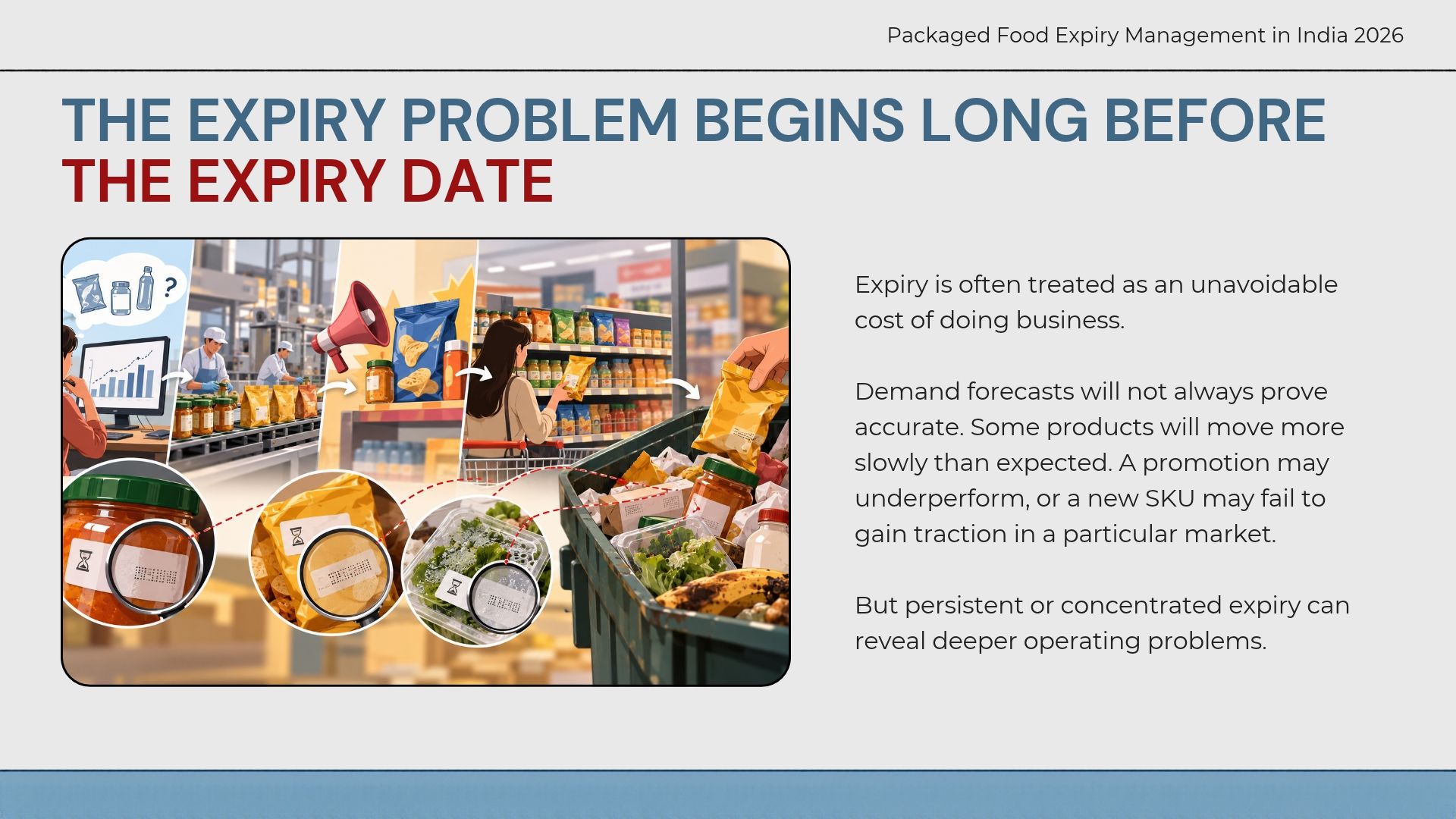
Demand forecasts will not always prove accurate. Some products will move more slowly than expected. A promotion may underperform, or a new SKU may fail to gain traction in a particular market.
But persistent or concentrated expiry can reveal deeper operating problems.
A product may have been manufactured against an optimistic forecast, allocated to the wrong geography, pushed into an unsuitable channel or dispatched with inadequate remaining shelf life.
Excessive assortment, ineffective promotions and sales incentives linked to distributor dispatch rather than consumer sell-through can compound the problem.
What eventually appears as a warehouse write-off may therefore be evidence of an earlier failure in portfolio planning, forecasting, replenishment or channel governance.
Expiry management should begin with preventing avoidable inventory from reaching the end of its commercial life.
However, prevention addresses only part of the risk. Businesses also need to know what happens to a product after it expires.
Once expired inventory is identified, the immediate financial response is relatively straightforward.
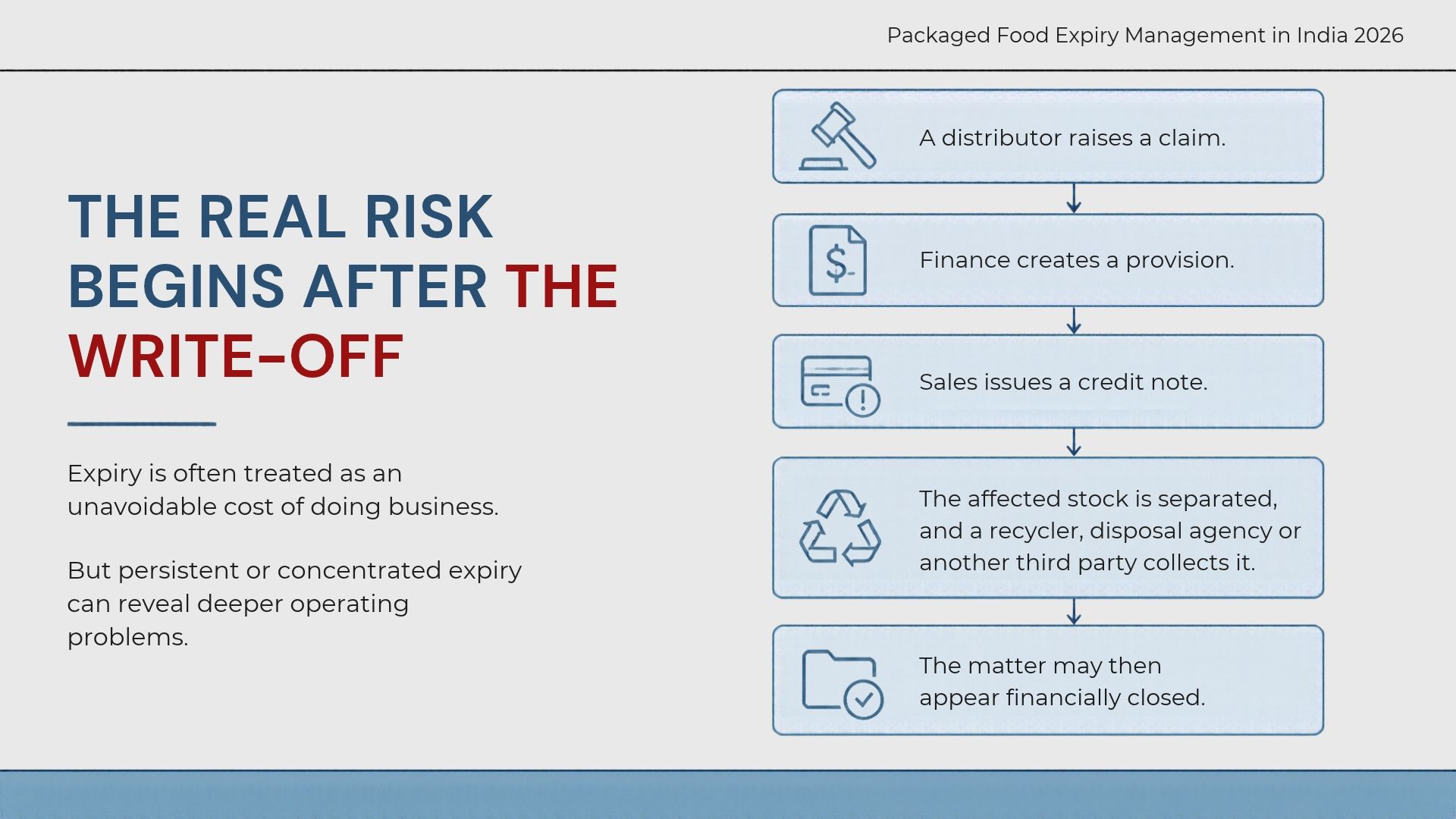
A distributor raises a claim. Finance creates a provision. Sales issues a credit note. The affected stock is separated, and a recycler, disposal agency or another third party collects it.
The matter may then appear financially closed.
But accounting closure is not the same as risk closure.
A provision records an anticipated loss. It does not establish what physically happened to the product. A credit note settles a commercial transaction. It does not prove that the expired stock was permanently removed from circulation.
For the brand, the risk remains open until there is credible evidence that the product was recovered, segregated, transported through an authorized channel and taken to a verifiable end-of-life destination.
That is where expiry management becomes a question of custody, traceability and final closure.
A responsible packaged-food company should be able to answer several fundamental questions:
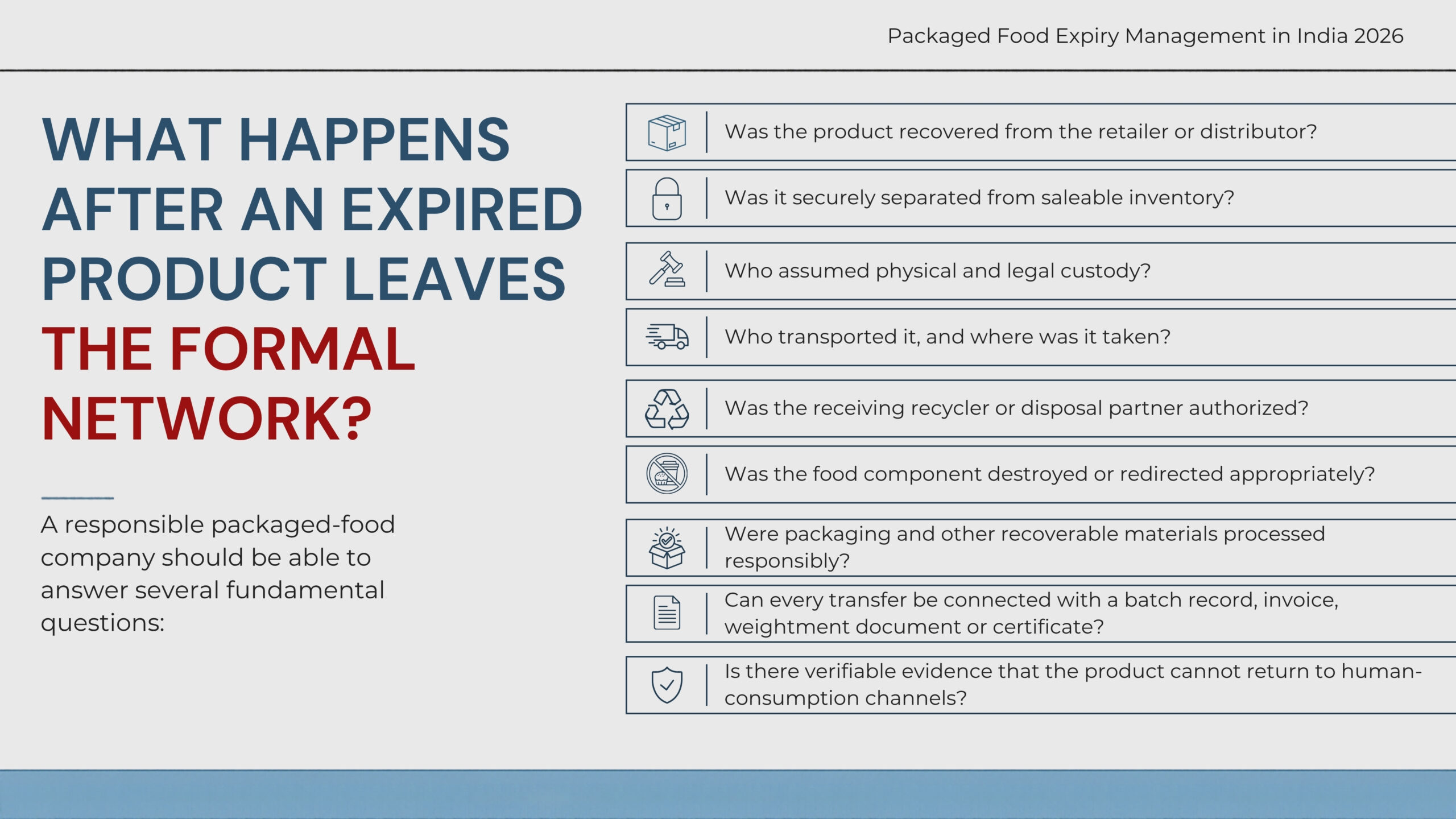
If these questions cannot be answered, the company may know that it has written off the inventory without knowing whether the product has truly left the market.
The vulnerability increases once stock moves beyond the visible distribution network. Products may pass through recyclers, scrap dealers, liquidators, auction buyers or other intermediaries.
Batch identity may be lost, ownership may become unclear, and documentation may end at the first handover.
That loss of visibility creates the conditions in which expired food can potentially be relabeled, repackaged or returned to sale.
Expired packaged food can contain legitimate recovery value.
Paper, cardboard, glass, metal, rigid plastic, flexible packaging and pallets may have appropriate recycling pathways. The food component may also have legally permitted non-human-consumption applications, subject to suitable safety and processing requirements.
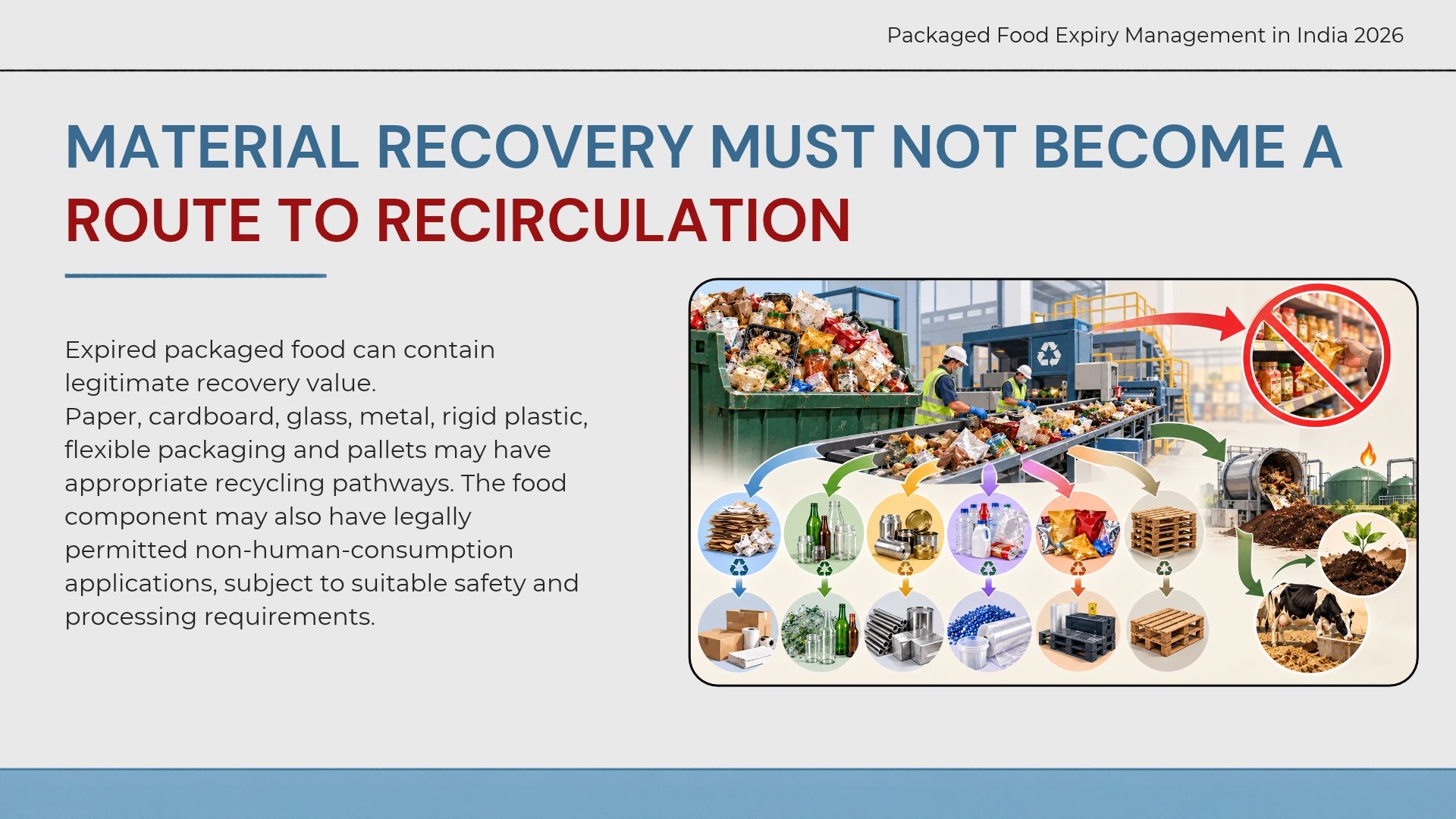
Legitimate material recovery should not be confused with illegal recirculation.
The risk arises when recovery processes involve multiple intermediaries, unclear ownership, weak records and limited physical verification. It becomes greater when the food and packaging remain intact, allowing the original product to be resold with relatively little intervention.
Terms such as “recycling,” “scrap,” “cattle feed” or “alternative use” should therefore not automatically satisfy a brand’s governance requirements.
Companies need verifiable evidence showing what ultimately happened to both the food and its packaging.
Recent enforcement actions demonstrate that the risk is neither hypothetical nor isolated.
In July 2026, authorities uncovered an alleged organized operation involving expired and near-expiry packaged food in the Okhla Industrial Area.
Investigators reported finding products whose original manufacturing and expiry information had allegedly been erased using chemical thinners. Replacement dates, labels, batch numbers and barcodes were reportedly applied before resale.
Products worth more than ₹20 lakh were seized, together with printing, sealing and date-modification equipment. Seven people were arrested in connection with the alleged operation.
Between August 24 and 29, 2026, the Maharashtra Food and Drug Administration and the Navi Mumbai Police Crime Branch investigated a facility in Turbhe.
Authorities reported finding equipment and chemicals allegedly being used to alter manufacturing dates, expiry dates and nutritional information on packaged-food products connected with several exporters.
Food stock and expired or unlabeled goods valued at more than ₹76 lakh were reportedly seized. The establishment’s food license was suspended.
In September 2026, Karnataka food-safety authorities reported seizing expired and incorrectly labeled food during inspections of storage and fulfillment facilities in and around Bengaluru.
The department reported the seizure of expired and improperly labeled food valued at ₹1.38 crore. A separate allegation involved an operator accused of purchasing expired products and forging replacement dates before resale.
Taken together, these cases reveal a recurring alleged pattern: expired or near-expiry inventory is aggregated, original product information is removed or concealed, replacement dates or labels are produced, and the goods are prepared for recirculation.
They also show why the expiry conversation cannot end after a financial write-off.
The physical product continues to exist, and so does the risk attached to it.
A manufacturer’s name may remain highly visible on diverted or allegedly tampered inventory. That does not establish that the manufacturer participated in the misconduct.
Several enforcement cases involve independent warehouses, traders, exporters, liquidators or other third parties handling branded products outside authorized channels.
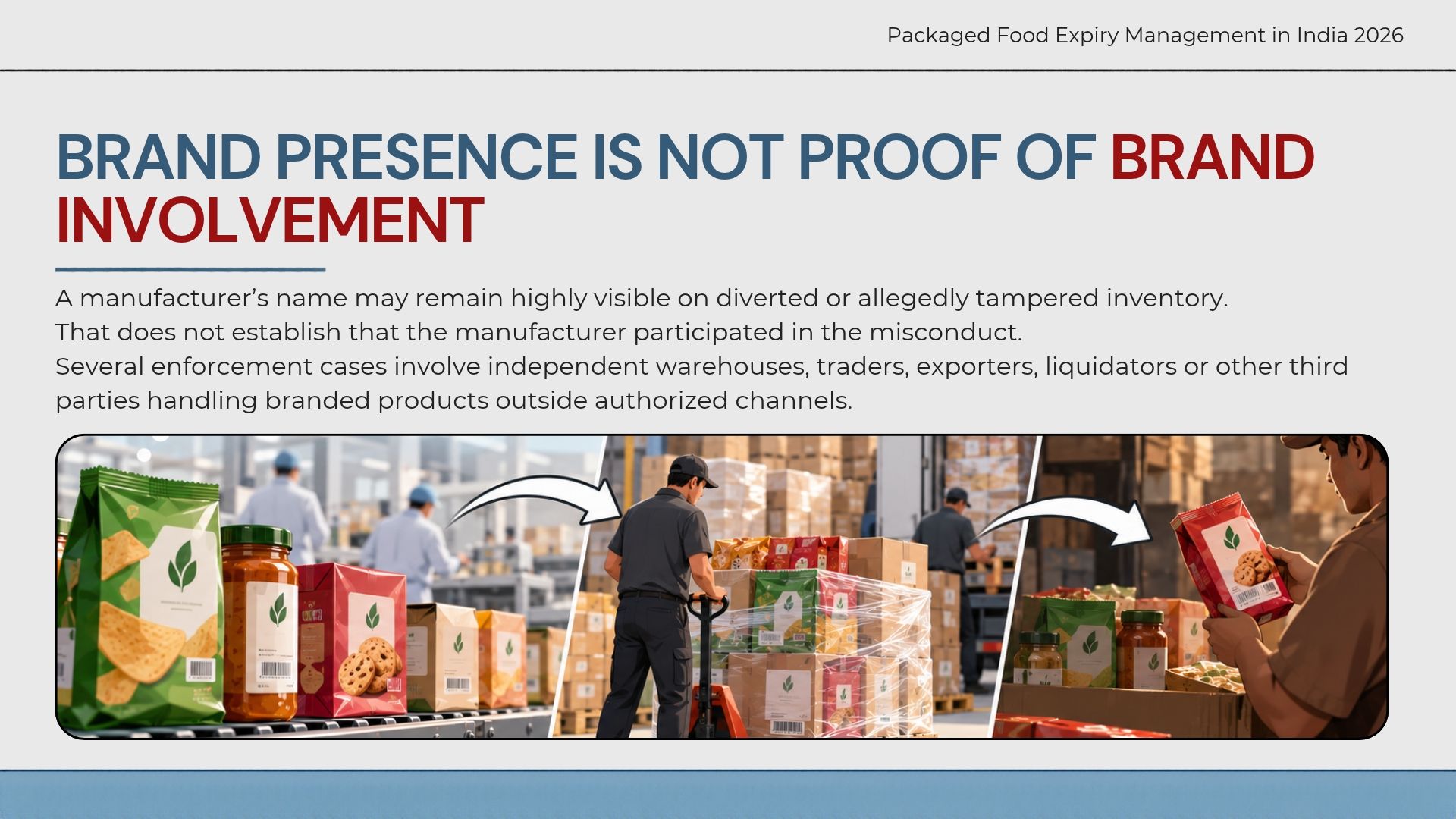
This distinction is important for accuracy and fairness.
Public perception, however, may not make the distinction so carefully. The brand name printed on the package can quickly dominate news coverage, search results and consumer concerns.
This gives companies a strong reason to maintain traceability beyond the first transfer.
A business should be able to demonstrate when the product left its authorized network, which party received it, whether it had already been returned or credited, and what records exist concerning its intended disposal.
Without that evidence, even an uninvolved manufacturer may struggle to respond quickly and convincingly.
The regulatory direction already recognizes this requirement.
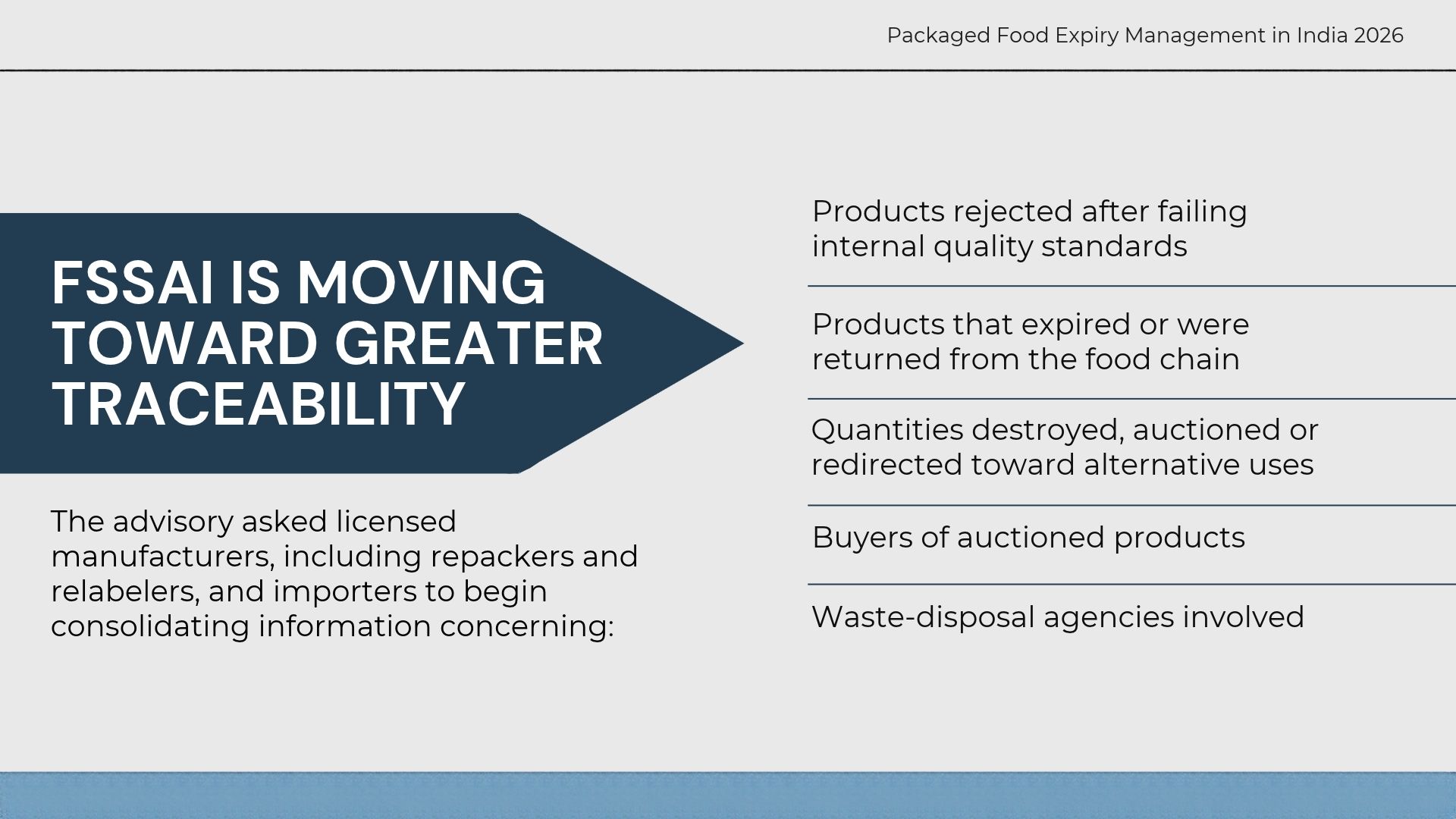
On December 16, 2024, the Food Safety and Standards Authority of India issued an advisory concerning quarterly submission of information on rejected and expired food.
The advisory asked licensed manufacturers, including repackers and relabelers, and importers to begin consolidating information concerning:
FSSAI stated that a reporting provision would be introduced through FoSCoS. The stated objective included preventing expired or rejected food from being resold for human consumption under the guise of cattle feed or another alternative use. [fssai.gov.in], [fcainfoweb.nic.in]
Existing licensing requirements also provide for the segregation and distinguishable marking of rejected, recalled, returned and expired materials. They require the use of first-in-first-out or first-expire-first-out systems where applicable.
These are important foundations, but regulatory reporting should become the minimum threshold rather than the full extent of a company’s ambition.
Reporting that stock was handed over to a disposal partner establishes only the first transfer. It does not necessarily prove what happened after that point.
Expiry management must move from a fragmented warehouse process to a formal boardroom agenda.
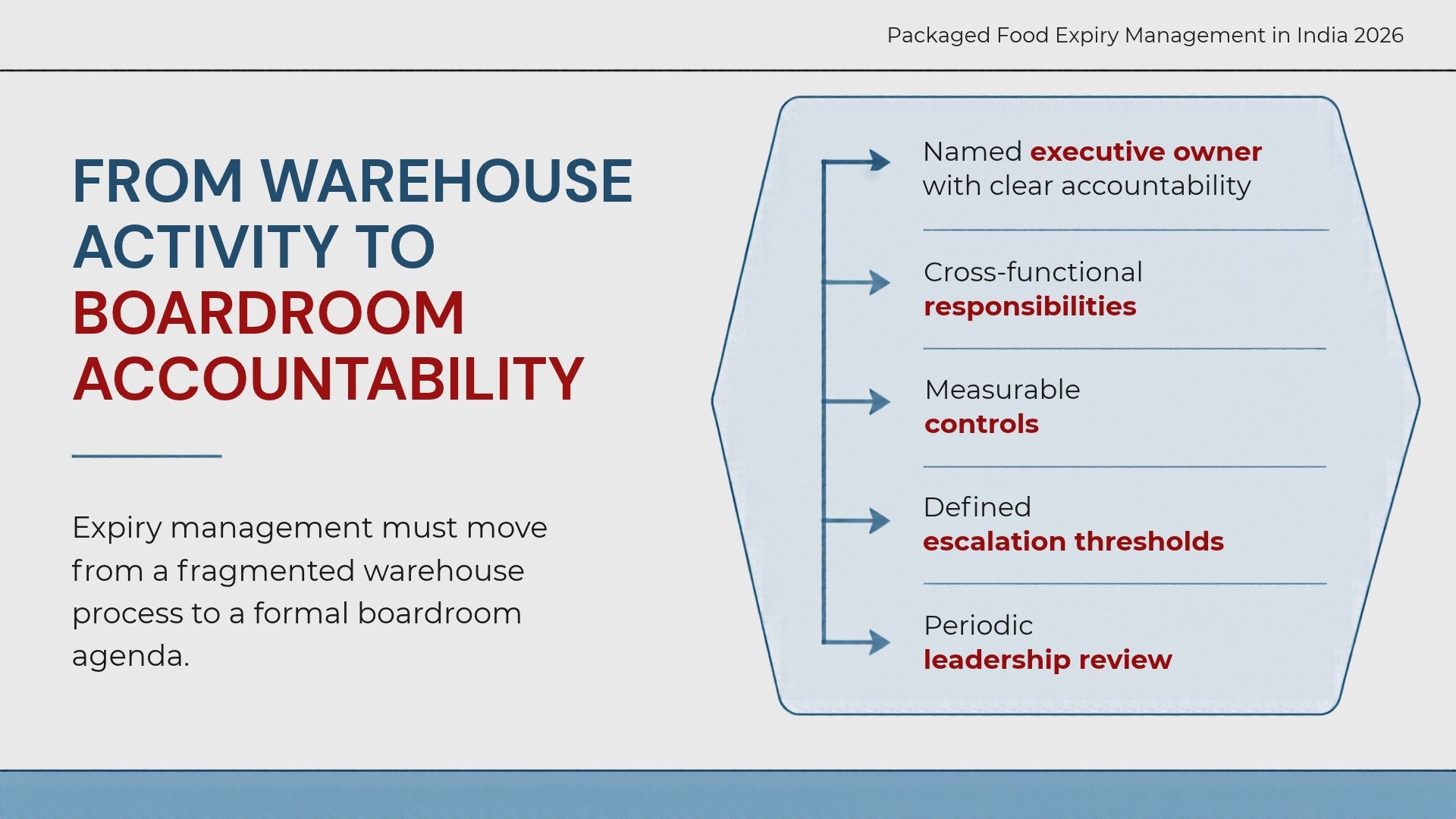
It requires a named executive owner, cross-functional responsibilities, measurable controls, escalation thresholds and periodic leadership review.
Sales teams influence how much stock enters a channel and whether incentives reward dispatch or actual sell-through. Supply-chain teams influence forecasting, replenishment and remaining shelf life. Finance determines how write-offs and credits are recognized.
Quality teams define segregation and disposal standards. Legal teams govern contracts and auctions. Sustainability teams measure food waste and material recovery. Technology teams determine whether batch-level visibility is possible.
When ownership is fragmented across these functions, expiry can become everyone’s responsibility and no one’s accountability.
A stronger operating model should identify who owns the overall outcome, who has the authority to intervene, and which exceptions require escalation to executive leadership or the board.
An aggregate expiry percentage provides limited management insight.
A company may report that expiry represents 4% of sales without recognizing that a small number of products, distributors or markets account for most of the loss.
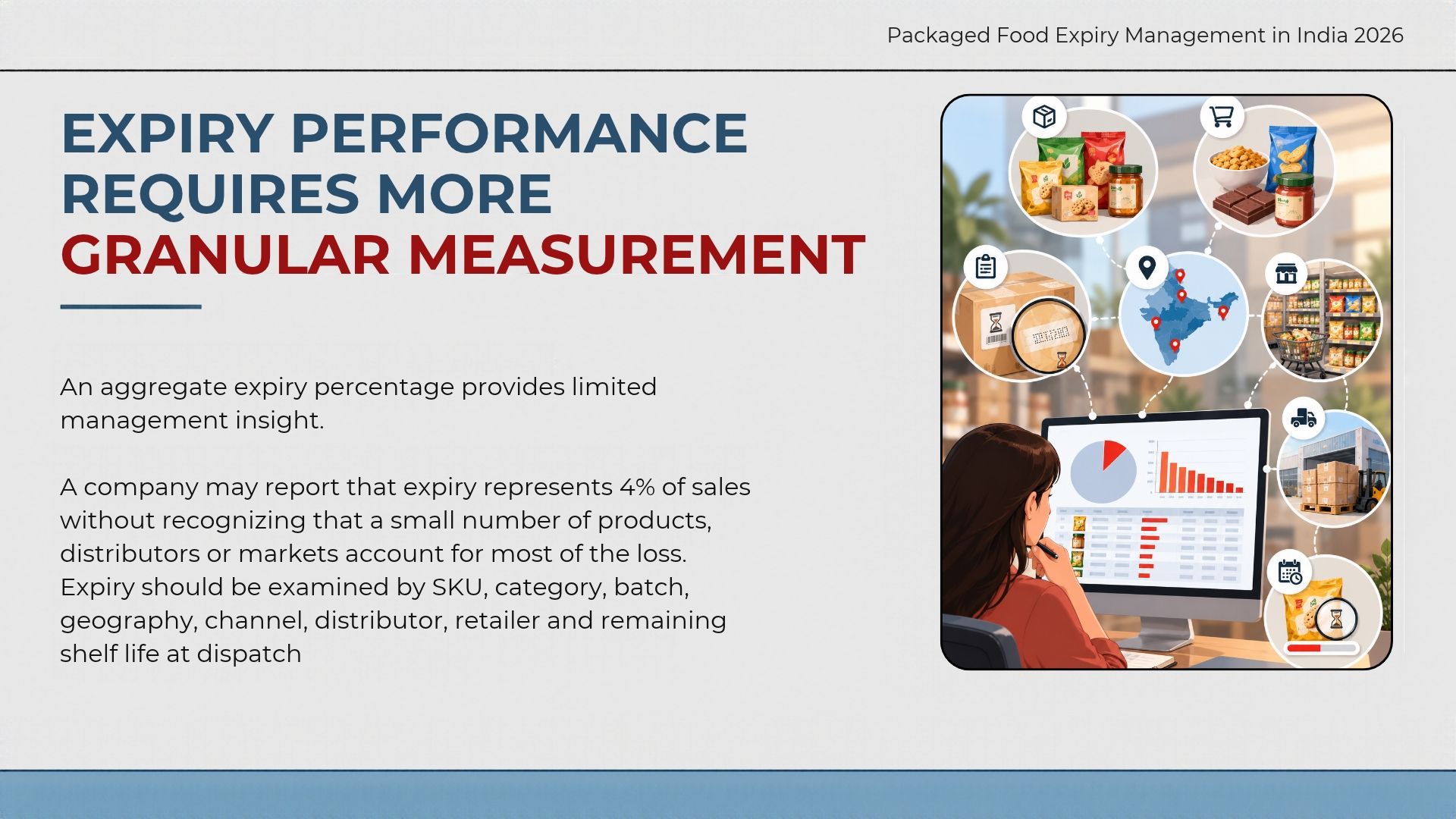
Expiry should be examined by SKU, category, batch, geography, channel, distributor, retailer and remaining shelf life at dispatch.
Greater granularity makes expiry a diagnostic tool.
A concentration in one product family may point to assortment proliferation or weak launch assumptions. Repeated expiry at one distributor may indicate overstocking or ineffective stock rotation. A spike in one channel may show that the pack size, price point or product proposition does not suit the purchase occasion.
Remaining shelf life at dispatch is especially important. A product may be technically saleable when it reaches a distributor while having insufficient time to move through the channel normally.
The objective is not merely to record how much expired. It is to understand why it expired and prevent a recurrence.
A comprehensive packaged-food expiry-management program should include ten connected capabilities:
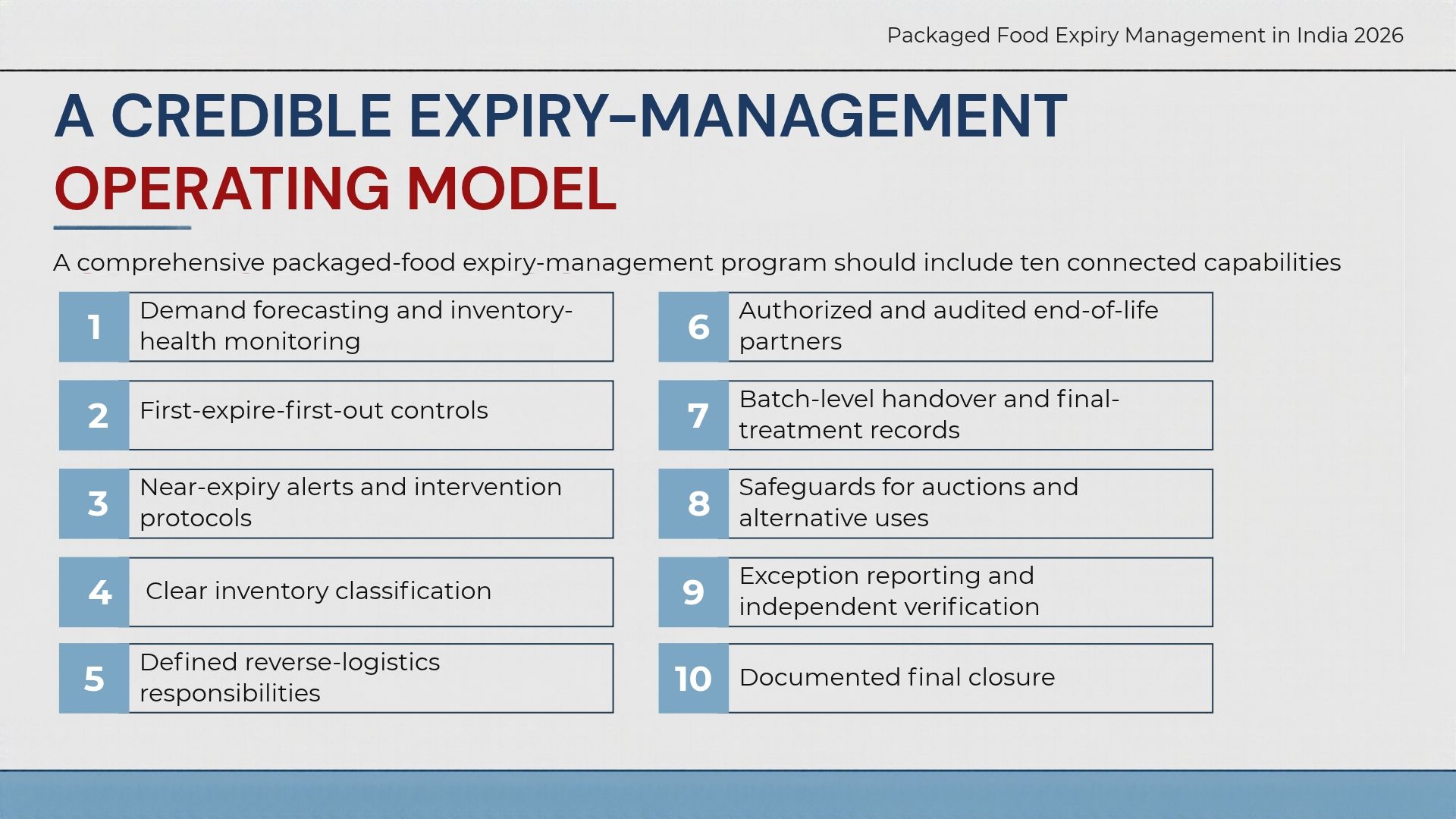
These controls must operate as one system.
Improving stock rotation without strengthening reverse logistics may reduce some expiry but leave end-of-life risk unresolved. Auditing disposal partners without addressing overproduction improves closure but allows avoidable losses to continue.
The objective is to manage the full product lifecycle.
Expiry traceability does not necessarily require one complex technology platform from the beginning.
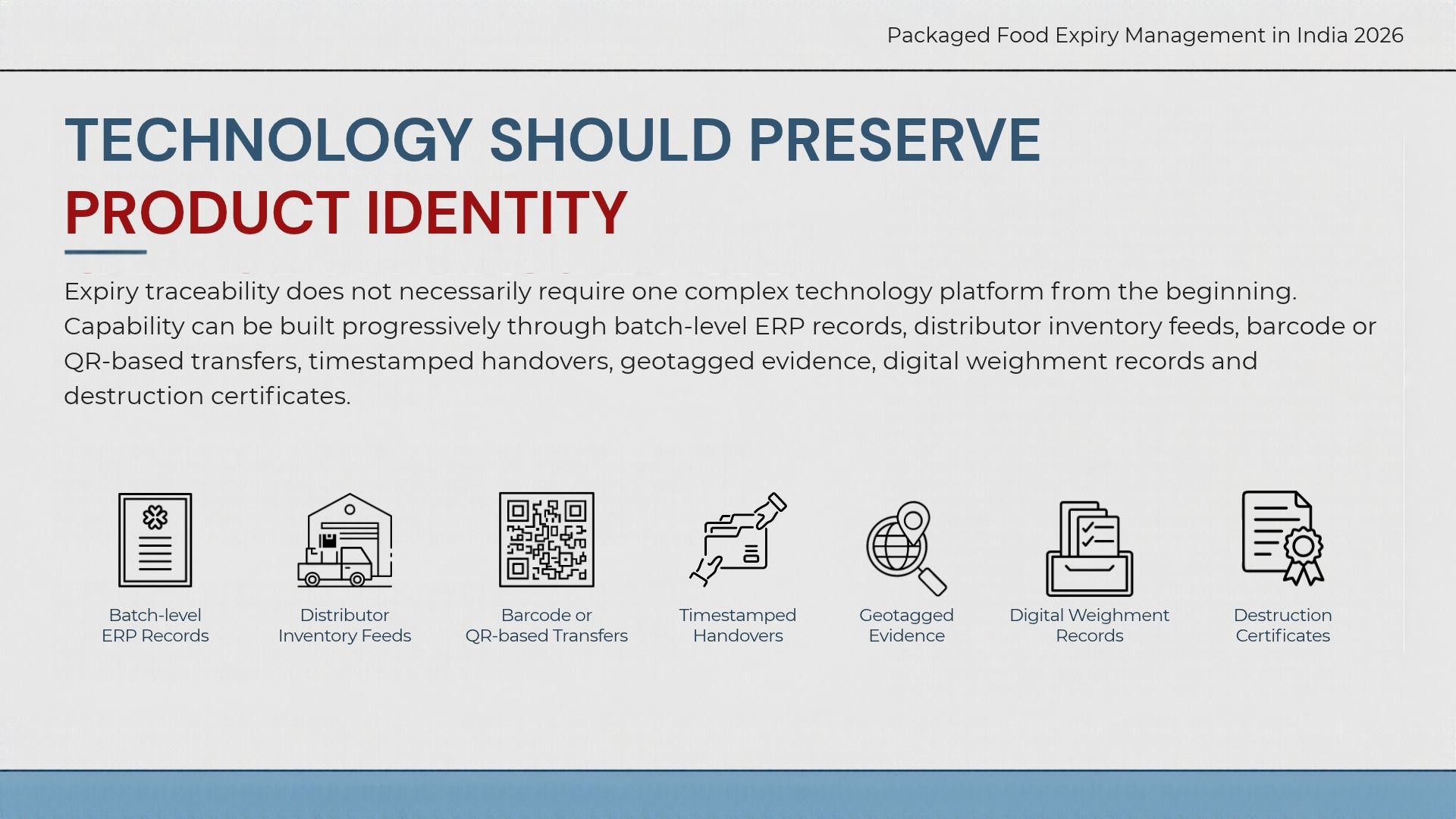
Capability can be built progressively through batch-level ERP records, distributor inventory feeds, barcode or QR-based transfers, timestamped handovers, geotagged evidence, digital weighment records and destruction certificates.
The purpose of technology is not digitization for its own sake.
It is to ensure that every batch retains a verifiable identity until final closure.
Technology should also support reconciliation. The quantity recovered from distributors and retailers should correspond with the quantity received and processed by the final partner, with reasonable and documented adjustments.
A certificate should be treated as one part of the evidence, not as a substitute for physical and documentary governance.
Margin pressure may discourage companies from investing in reverse logistics, partner audits, traceability technology and verified disposal.
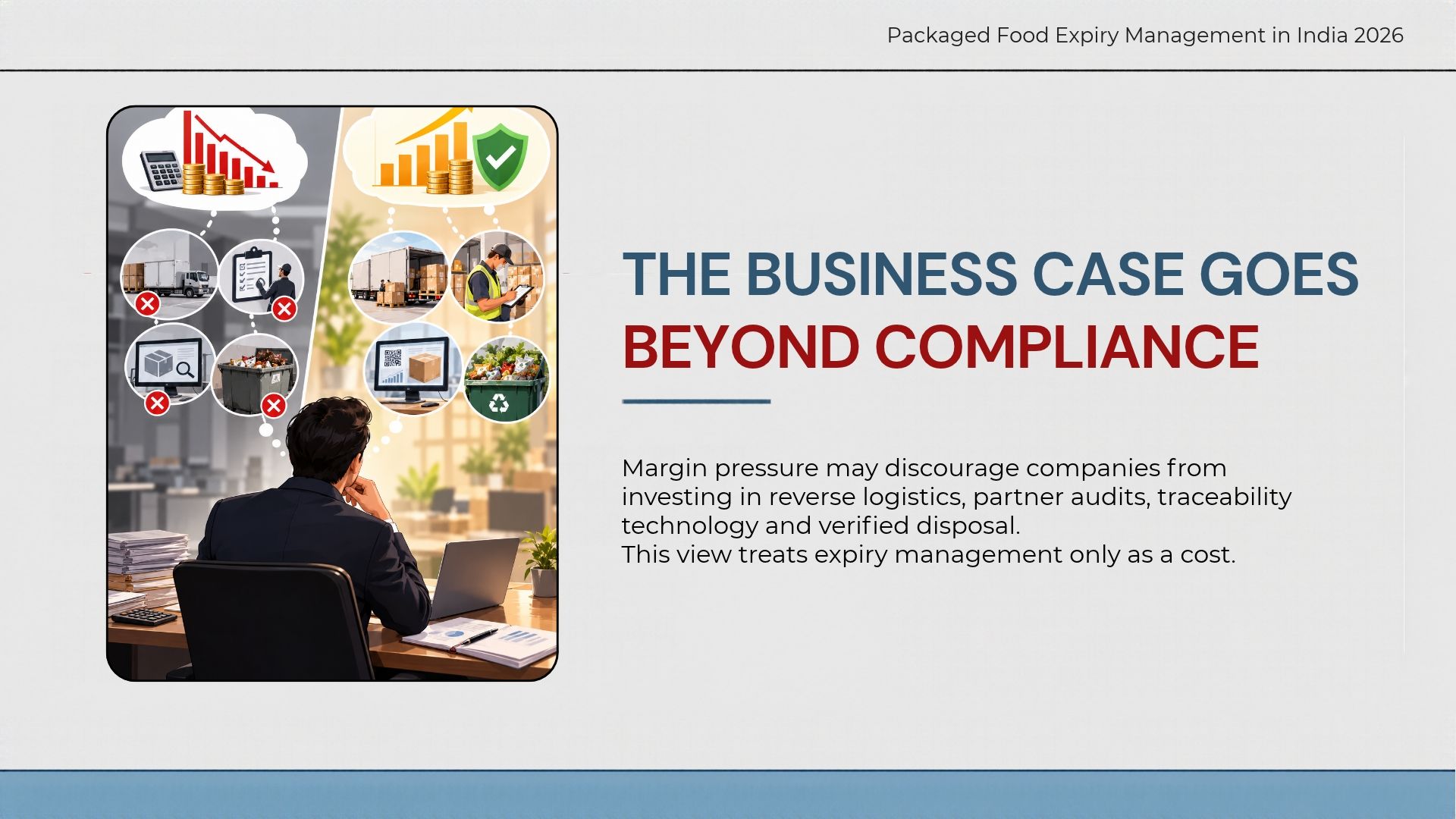
This view treats expiry management only as a cost.
It overlooks the losses created by overproduction, poor forecasting, excessive assortment, weak channel discipline, product seizure, regulatory intervention and reputational damage.
A stronger expiry-management program can reduce avoidable inventory losses, release working capital and improve distributor accountability. It can support food-waste and packaging-recovery goals through more credible data. It can also provide defensible evidence when branded products are found outside approved channels.
Most importantly, it protects brand equity.
Food-safety news can spread faster than a company’s response. Consumers may see a familiar logo on an allegedly tampered product before learning who owned the stock or where the misconduct occurred.
A credible response depends on rapid traceability.
Without it, communication may sound defensive. With it, the company can distinguish clearly between authorized activity and external wrongdoing.
Expiry management should not end with a financial provision.
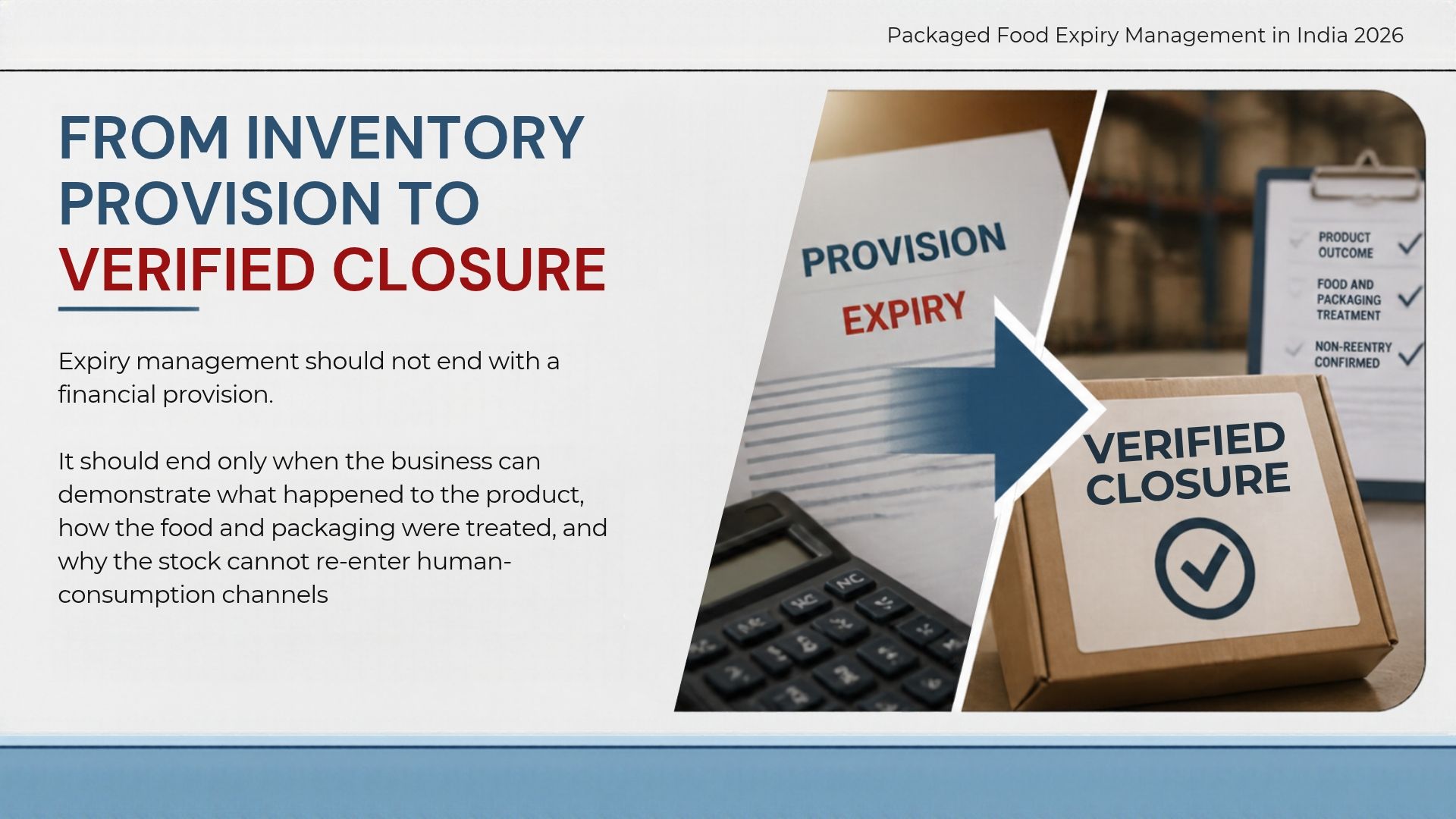
It should end only when the business can demonstrate what happened to the product, how the food and packaging were treated, and why the stock cannot re-enter human-consumption channels.
For India’s packaged-food industry, the opportunity is clear.
Brands can reduce avoidable expiry through better planning, disciplined portfolios, stronger FEFO controls and improved channel visibility. They can recover expired products systematically, preserve batch identity and verify final treatment.
The objective is not only to reduce write-offs.
It is to ensure that expired products never lose their traceable identity after leaving the formal network.
The Knowledge Company works with packaged-food and FMCG businesses to design and implement end-to-end expiry-management programs.
TKC can help companies:
By integrating strategy, operations, supply chain, governance, technology and performance improvement, TKC helps businesses move from fragmented expiry handling to a systematic and accountable operating model.
Is your organization able to trace expired inventory from recovery to final closure?
To assess your expiry exposure and build an end-to-end packaged-food expiry-management framework, contact The Knowledge Company at vidya@tkc.in.
Get the strategy behind the retail headlines. Subscribe to TKC’s free newsletter: https://lnkd.in/eh-_58pf