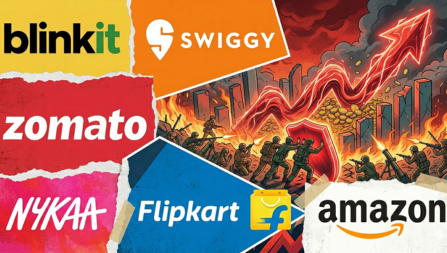
India’s listed new-age consumer internet firms have just come
through a relatively steady March quarter, with most reporting revenue growth
broadly in line with expectations and improving operating metrics. Yet, as
highlighted in a recent ETtech report, the next leg of this journey looks far
more challenging. Rising fuel, packaging, freight and raw material costs are
converging with uneven consumer sentiment, particularly across food delivery,
quick commerce, ecommerce, beauty, eyewear, furniture and logistics.
Arvind Singhal, Chairman of The Knowledge Company (TKC), believes
this evolving environment is less about panic and more about a rigorous stress
test of business fundamentals.
The Shift from Growth to Resilience over the last few years, most internet-first platforms have been rewarded for topline growth, category expansion and customer acquisition at scale. However, the ETtech coverage underlines a critical transition: from chasing GMV to defending contribution margins in the face of exogenous cost shocks.
According to the report, while headline revenue growth in the
March quarter remained healthy, cost lines linked to logistics and customer
fulfilment are now under pressure, driven by higher energy prices, packaging
material inflation and restructuring of supply chains due to geopolitical
developments.
“The next two quarters will be a real test of resilience for these
platforms. Consumer sentiment is already fragile, and there is limited headroom
to push through 8–10% price hikes without denting demand. The real competitive
advantage will come from operational efficiency, delivery density and
disciplined cost control – not just discounting,” says Arvind Singhal.
Why Internet-First Models Have Less Room to Manoeuvre
Traditional FMCG players facing input cost inflation have long
relied on a familiar playbook: shrinkflation, grammage tweaks, portfolio mix
changes and calibrated price hikes.
The ETtech story points out that listed internet companies, by
contrast, have a much narrower set of levers.
- They cannot easily
“resize” a delivery the way an FMCG firm can resize a pack.
- A large share of their
cost base is variable (last-mile, incentives, reverse logistics), which
responds immediately to fuel or wage inflation.
- Customers are habituated
to free or low-cost delivery, generous return policies and frequent
promotional events, which reduces the space for passing on cost spikes.
For categories such as furniture and large-format ecommerce,
higher freight and warehousing costs can compress margins significantly, even
when reported revenue continues to grow. Quick commerce and food delivery
players face a similar squeeze, with delivery cost inflation colliding with
consumers’ reluctance to accept higher delivery or platform fees.
READ THE FULL STORY AT:
https://economictimes.indiatimes.com/tech/technology/listed-new-age-internet-firms-brace-for-a-costly-ride-as-war-clouds-math/articleshow/131376691.cms?from=mdr
Where the Next Phase of Differentiation Will Come From
In Arvind Singhal’s view, this is the phase where operational
sophistication will matter more than app design or campaign creativity. Firms
that have invested in improving delivery density, route optimisation,
dark-store productivity, and intelligent assortment are better positioned to
absorb cost shocks without constant firefighting.
Equally important is discipline on customer acquisition and
retention spends. As ETtech notes, companies that are still using discounts as
a primary lever to keep volumes growing will find their economics increasingly
fragile when every percentage point of margin is contested by energy, packaging
and wage costs.
The platforms that emerge stronger will likely share three
characteristics:
- A clear path to
sustainable contribution margin at the category level.
- A data-driven approach
to network optimisation and demand clustering.
- The willingness to walk
away from unprofitable cohorts, geographies or service promises.
How TKC Helps Internet Businesses Navigate the Stress Test
The Knowledge Company’s Digital & Consumer Internet practice
works with listed and growth-stage platforms to strengthen their resilience
playbook in exactly this kind of environment.
Typical engagement themes include:
- Profitability
Diagnostics: Deep dives into category-level unit economics to identify
where cost inflation is structurally undermining margins versus where it
can be engineered out.
- Network & Delivery
Optimisation: Redesigning fulfilment footprints, delivery zones and SLAs
to balance customer experience with cost-to-serve.
- Pricing & Promotion
Architecture: Helping platforms move away from blunt discounting to
intelligent, segmented offers that sustain demand without eroding
structural profitability.
- Scenario Planning for
Cost Shocks: Building playbooks for fuel price spikes, packaging
inflation, or cross-border supply disruptions so response is pre-planned,
not reactive.
If you are a consumer internet or platform business, the next
12–18 months are less about headline growth and more about proving that your
model can withstand recurring cost and demand shocks.
Is your unit economics framework ready for a real-world stress
test?
Connect with TKC’s Advisory
Team to evaluate how robust your
profitability engine really is.