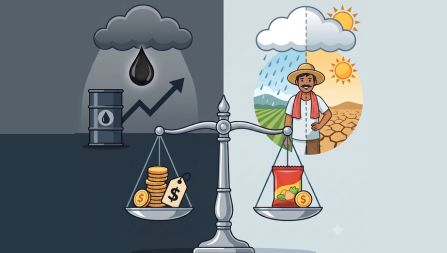
The corporate landscape for India’s Fast-Moving Consumer Goods (FMCG) sector has suddenly hit a volatile patch. The rapid dissolution of the US-Iran peace deal has immediately reverberated through global commodity markets, renewing concerns over spiking crude oil prices and systemic supply chain disruptions.
For a sector that spent the early months of the year restructuring strategies to favor volume-led growth over inflation-driven price increases, this sudden macroeconomic shift introduces a complicated variable. Crude price increases directly inflate the costs of petroleum-linked raw materials, affecting everything from plastic packaging to critical ingredients used in personal care and home care products.
Yet, while public equity markets reacted with immediate nervousness, the operational reality inside consumer boardrooms is far more measured.
Evaluating the unfolding situation for Mint, Arvind Singhal, Chairman of The Knowledge Company (TKC), clarifies why quick strategic shifts are practically impossible and where corporate attention is truly anchored.
Read the full analysis on Mint: https://www.livemint.com/news/consumer-firms-could-face-jitters-as-us-iran-ceasefire-falls-through-11783515927582.html
- Navigating the 2-to-6 Month Strategy Lag
When geopolitical headlines shift, market commentators often expect immediate corporate maneuvers. However, large-scale consumer goods operations do not possess the agility of financial markets. Procurement pipelines, raw material hedging contracts, and distribution frameworks are locked in months in advance.
“I don’t think companies can react on this kind of a short notice,” explains Arvind Singhal. “It takes 2-6 months to make any change in your plans and strategy. I think right now the Indian FMCG companies will be watching the progress of monsoon more carefully than the Strait of Hormuz.”
Any structural modification to product grammage, pricing architectures, or factory output requires extensive lead time. Consequently, companies are inherently built to absorb short-term price shocks or let existing hedges play out before executing sweeping changes to their market approach.
- Why the Monsoon Outweighs Geopolitics
For Indian consumer firms, demand fundamentals are dictated far more by domestic rural health than by external geopolitical bottlenecks.
While a conflict in West Asia threatens the supply side via raw material costs, the demand side of the Indian FMCG equation is determined by the southwest monsoon. If agricultural output is robust and rural incomes recover sustainably, consumer companies can successfully navigate minor margin compressions through volume expansion. Conversely, even with low oil prices, a weak monsoon crippling rural consumption can severely depress sector performance.
Therefore, tracking internal rain deficits and rural wallet health remains the primary focus for corporate decision-makers.
- The Government Policy Insulator
The ultimate downstream impact of global oil price fluctuations on the Indian consumer’s wallet remains highly dependent on fiscal intervention. Domestic fuel pricing acts as a crucial cushion or a conductor of global inflation.
“As far as the crude prices are concerned, that is probably the only variable where the government has to decide as far as pricing of crude or the petroleum in India is concerned,” Singhal notes.
How the government balances state revenue needs against retail inflation concerns will determine the actual extent of transport and logistics pressure passed down to consumer goods companies.
The Strategic Outlook: Keeping a Steady Hand
Renewed inflationary threats arrive at an awkward time for a sector attempting to transition away from structural down-trading and shrinkflation. However, the core takeaway for FMCG leadership is to avoid knee-jerk operational course corrections.
By closely monitoring rural economic indicators, optimizing supply chains against temporary logistical delays, and keeping an eye on domestic policy signals, companies can build the resilience required to weather global headwinds without sacrificing their long-term growth trajectories.
Bulletproof Your Consumer Strategy with TKC
The Knowledge Company’s Consumer Goods & Retail practice works alongside leading domestic and multinational FMCG brands to navigate complex macroeconomic cycles and evolving retail landscapes.
- Macroeconomic Risk Management: We help corporate leadership structure agile procurement and operational frameworks to absorb input cost volatility.
- Rural Demand Frameworks: Assisting brands in mapping and capturing rural market share based on deep consumer behavior tracking across varied topographies.
- Pricing & Portfolio Optimization: Structuring robust pricing and product grammage architectures that protect corporate margins without alienating price-sensitive demographics.
Is your operational model insulated against the next wave of macroeconomic volatility? Connect with TKC’s Consumer Advisory Team to build a more resilient route-to-market strategy today.