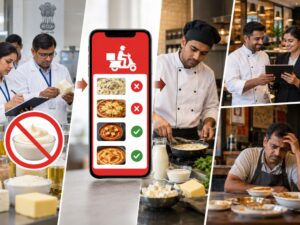
India’s quick commerce (Q-commerce) sector is undergoing a profound structural evolution. While the narrative has historically been driven by headline-grabbing 10-minute delivery promises, the operational reality on the ground tells a very different story. The true battleground is shifting away from pure delivery speeds and moving squarely into the complexities of the fresh-produce supply chain.
As recently reported by Mint, global e-commerce giant Amazon is aggressively positioning itself to catch up in this high-stakes race. The company plans to scale its instant-delivery service, Amazon Now, from 20 cities to 100 cities through a network of over 1,000 micro-fulfillment centers. Crucially, Amazon is betting on its years-in-the-making grocery backbone, built via Amazon Fresh, to fuel this rapid expansion.
Read the complete article at: https://www.livemint.com/companies/amazon-quick-commerce-strategy-amazon-now-and-fresh-11780381889610.html?giftCode=87-e9a9d20fce8
Commenting on this strategic shift, Arvind Singhal, Chairman of The Knowledge Company (TKC), highlighted why the fresh produce category remains an incredibly difficult puzzle to solve in the Indian market.
The Complex Reality of Managing “Fresh”
While rivals like Blinkit, Zepto, Swiggy Instamart, and BigBasket continue to aggressively deepen their hyperlocal infrastructure, Amazon is leaning heavily on a shared sourcing, processing, and cold-chain network that already interfaces with over 16,000 farmers and aggregators.
According to Arvind Singhal, this back-end capability is where the real war will be won or lost.
“Fresh remains one of the most difficult categories to manage consistently in Indian retail, whether online or offline, given fragmented farming, regional preference differences and quality-control complexities,” Singhal told Mint. “Fresh is something nobody in India has been able to crack.”
Because agricultural sourcing in India is highly fragmented and localized, achieving a standardized baseline for fruits and vegetables across hundreds of micro-neighborhoods is an monumental task. The challenges range from managing rapid perishability and handling high rejection rates to ensuring optimized cold-chain movement in extreme weather conditions.
Why Speed is No Longer the Ultimate Moat
In the initial phase of quick commerce, rapid delivery speed was the primary customer acquisition tool. However, as the novelty wears off and consumers integrate these platforms into their daily household routines, their expectations are maturing. Speed is a baseline expectation; quality and availability are the retention metrics.
“Speed cannot be the only advantage in quick commerce,” Singhal noted. “If you can build confidence with consumers through supply-chain quality and sorting, I don’t see a reason why they cannot succeed.”
Amazon’s approach of utilizing a backbone where the majority of fresh produce is sourced within 200 kilometers of the end consumer reflects this logic. It acknowledges that backend depth and fulfillment predictability matter significantly more than shaving an extra two minutes off a delivery route.
The Next Phase: Focus on Profitability and Assortment
As India’s quick commerce sector enters a more mature phase, the unit economics of these platforms will come under intense scrutiny. To sustain profitability, operators can no longer rely purely on low-margin impulse purchases or packaged goods; they must dominate high-frequency, high-margin categories like fresh foods, meats, and gourmet products.
Ultimately, the platforms that succeed over the next decade will be those that view Q-commerce not merely as a logistics and delivery business, but as a deeply integrated cold-chain and agricultural sourcing business.
Optimizing Route-to-Market & Supply Chains with TKC
The Knowledge Company’s Retail & Supply Chain practice advises leading global enterprises and domestic giants on navigating the realities of the Indian retail ecosystem.
- Cold-Chain & Logistics Strategy: We help brands design and optimize robust back-end networks capable of managing perishable inventory with minimal wastage.
- Hyperlocal Distribution Blueprints: Assisting retail operators in structuring dark store and micro-fulfillment center models that balance speed with commercial viability.
- Vendor & Sourcing Integration: Advising organizations on streamlining fragmented agricultural and procurement networks to ensure consistent product sorting and quality control.
Is your retail supply chain equipped to handle the demands of the modern consumer? Connect with TKC’s Advisory Team to bulletproof your distribution strategy today.